Thursday, May 25, 2023

Seals get serious about resting

Adult females join youngsters to molt 

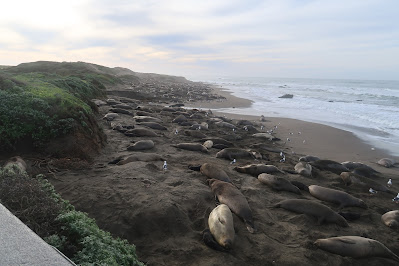
May actually brings more elephant seals to the Piedras Blancas beach than the winter breeding season. Lots of seals, doing a lot of sleeping.


That’s because all the adult females and the not-yet-mature juveniles begin arriving in April and linger on the beach through June. The females left the beach after giving birth and mating to get next year’s pup started in February and March. They’ve been regaining weight lost to their nursing pups, so that they are physically strong enough to support another pregnancy.

The juveniles left the beach to the breeding adults during the winter. They return to the calmer beach of spring.

All will molt their skin during their stay.

Molting

The old brown skin and hair peels off in chunks, exposing new skin and hair underneath. Look for pearly gray seals next to brown and tan seals. Check out the ones with skin curling off around eyes and nose. Old scars also start peeling back the molted skin. You may see a marked seal. Check with a docent or contact elephantseal.org to report a marked seal. All marks are temporary, since they come off with the molted skin.


Female migration

Unseen, the egg fertilized in mating two months ago has suspended development during the short post-breeding migration. After molting it implants in the uterine wall and begins developing into a pup.

After resting and molting in May and June, the juveniles go to sea until they return for the fall haul-out. The pregnant females will leave on their long migration, to return in January to give birth to their pups.

Seals and Floating Offshore Wind turbines

Elephant seals are one of the many marine mammal, sea turtle, fish and marine bird species that are the subject of research efforts to investigate ocean conditions relative to Floating Offshore Wind projects.

The Coastal Commission was briefed at its May 11 meeting by energy company representatives, scientists, state agency representatives, fishermen and others. Watch the video recording of that briefing here. Slides and videos are in the Presentations drop-down menu.

Ben Ruttenberg, director of Cal Poly’s Center for Coastal Marine Sciences, gave a presentation on knowledge gaps in the deep ocean, at 57:23 into the video. At 4,000 feet, the depth off the Central Coast 20 miles offshore where wind turbines will be located, little is known. He proposes using Artificial Intelligence and machine learning to assist in the research.

Oceanography consultant Grace Chang gave a presentation on Upwelling at 1:13:54. Brandon Southall of UC Santa Cruz, Duke University, and his own company, Southall Environmental Associates, presented background on the effects of sound on marine mammals and sea turtles at 1:31:28. Josh Adams of the US Geological Survey is leading a team studying the effects on marine birds, at 1:53:25.

The entire briefing is of interest, but these presentations are especially significant for elephant seals and other wildlife. 

Ports

The Offshore Wind projects will also require substantial onshore support infrastructure. Morro Bay is being considered for Operations and Maintenance, but larger ports, such as Humboldt, Los Angeles and Long Beach, are needed for manufacturing and fabrication of the 1,100-foot turbines and for staging and integration, assembling the turbines and towing them out to sea.

They’ll also need waterfront and onshore upgrades for fueling, warehouses, offices, parking, and crew support services.

See port reports from the Bureau of Ocean Energy Management, California Floating Offshore WindRegional Ports Assessment;

the California State Lands Commission, “Alternative Port Assessment to Support OffshoreWind;”

and REACH Central Coast.


 https://www.sanluisobispo.com/news/local/environment/article275712876.html


Monday, April 24, 2023

Seal Star Quality!

Tracked seal delivers data 

Every day brings surprises at the Piedras Blancas elephant seal viewpoint, but April brought an especially exciting seal to the beach. Docents spotted her on April 5, with two tracking devices attached. One was on her head, the other on her back. She was carrying messages from long ago and far away.


Such electronic tracking devices are used by the research team at University of California Santa Cruz campus, so Friends of the Elephant Seal docents notified them right away.
Salma Abdel-Raheem, Ph.D. student in the Beltran Lab in the Department of Ecology and Evolutionary Biology, recognized the seal as one of her research subjects. The team worked with their colleague Dr. Dan Costa to get the State Park and National Oceanic and Atmospheric Administration permits required to go on to the beach and retrieve the devices.


All the pieces were in place to recover the devices on Easter Sunday, April 9. After carefully shooing away the other seals and giving the seal a sedative injection, they cut off the zip ties and electrical splicing tape holding the device to a mesh footprints glued to the fur. They also collected blood and tissue samples. Success!

 This journey began May 2022

The research team glued the tracking devices to this seal May 2, 2022 at Año Nuevo. The seal was two years old then, approaching adulthood from adolescence. She hauled out at Point Reyes a few months later, on September 19, and stayed to October 24, a typical juvenile haul-out.

“We tried to retrieve her tags during this period, but she was only accessible by boat and weather conditions were not favorable,” Ms. Abdel-Raheem said.

The seal left the beach on her next migration, and Piedras Blancas was the next they knew of her. That 342-day trip is the longest of any of the juvenile seals the team has tracked so far, nearly double the average trip of 184 days.

“We're really excited to see what she’s been up to in her year-long adventure!” Ms. Abdel-Raheem said.

 Successful foraging

She fed well during that migration, doubling her mass from 170 kgs (~375 lbs) in May 2022 to 344 kgs (~760 lbs) when they recovered her tags on April 9, more than any other seal the team has studied. 

She is beautiful and sleek, without any scars or defects. I thought she was absolutely perfect, a Rock Star of a seal. The FES docents started calling her Gigi.

Somewhere along the way, Gigi lost the VHF transmitter that allowed the team to find her on the beach. However, the tracking devices continued collecting data – salinity, depth, light, temperature, and accelerometers that measure the orientation of the animal in the water column as well as its speed and acceleration.

“We can put these data together to help us formulate an idea of what the seal is doing while out at sea. We can infer the number of prey capture attempts, the body condition via buoyancy, how much time the animal spends traveling, resting, or foraging, how the animal responds to changes in its environment,” Ms. Abdel-Raheem said. “These data are critical in informing our understanding of the ecology and physiology of this species throughout juvenile development.”

Along with Ms. Abdel-Raheem, the tag recovery team included her two lab-mates, Zea Premo and Milagros Rivera, and their adviser Dr. Roxanne Beltran. Zea is studying the development of diving physiology in juvenile seals by using the blood and tissue samples that they collect; Milagros is interested in the genetic diversity of northern elephant seals and uses the DNA samples to inform their research.

The mesh footprint that held the tracking devices will fall off as Gigi molts on the beach, now blending in among her sisters. Thanks, Gigi, and farewell.


Thursday, March 23, 2023

Pups survive storms


California’s coast has been pummeled by storms this winter. The pups born in this year’s breeding season continue to mature and develop. As they do, they leave the beach on their first migration. 


The beach has been much changed by the heavy rains and high tides. The north beach at the Piedras Blancas viewpoint has lost a lot of its sand. Few mothers raised pups on that beach this season. 


Much sand was washed off the south beach, too, and water gushing from the culvert carved a deep channel. 

Weanlings 

Fat weaned pups, weaners or weanlings, appear not to take much notice. Their blubber insulates them from cold and wet. They find a spot among their peers and settle into sleep. Look for roly-poly seals. 


Most have molted their black birth coats, although you may see some still peeling. After they have molted, they have the counter-shaded coat of mature seals, dark on the back and light on the belly. They look so perfect! No scars or marks of older seals, whose skin tells the story of depredations at sea and battles on land. 

They socialize in groups called pods. See them lying close to the base of the cliffs, or across the beach where they can avoid any adult seal mating or fighting. 

They take to the surf to practice holding their breath, swimming and diving. They have strong instincts, but need practice to polish their swimming and diving skills. They increase how long they can hold their breath. They need to stay under water long enough to catch food, and dive deep enough to avoid predators. 

Blubber into muscle 

They haven’t had anything to eat since their mothers left. They metabolize their blubber until they begin catching their own food. They take this time on the beach to exercise, turning some of that blubber into muscle. 


They are more likely to be in the water at night, but you may see them splashing around during the day. Their life deep in the ocean will require them to hunt in the dark depths. 

No one teaches them how to hunt. Although most survive on the beach, only half will survive that first migration. 

Few adult seals on the beach 

Few if any females remain on the beach. They have left after nursing their pups for a month or so and mating with one or more bulls on the way back to the ocean. After not eating for the entire birth and nursing time, they are at their physiological low point. Time to get back in their ocean home and feed to build up some blubber. 

They will return in April and May for the annual molt. They lose their old skin, replacing it with new skin underneath, once a year. 


A few bulls sleep on the beach. They, too, are at their thinnest. They may have gone more than three months without food. It’s the price of eternal vigilance for a beachmaster. 

Stranded weaners 

Underweight and exhausted weaners may strand on local beaches. If you see one on the beach, you can report it to the Marine Mammal Center 24-hour hotline, 415-289-7325 (SEAL). They will send out a team to evaluate it and rescue it if necessary.

Thursday, February 23, 2023

Bulls threaten for dominance

Somepups are already weaned

Elephant seal pups born since winter’s storms subsided are doing well at Piedras Blancas beaches. Some are already weaned, others are still to be born. Bulls threaten each other, and occasional battles break out. It’s breeding season at the beach.

Highway 1 is now open north of the elephant seal viewpoint. The parking lot has been graded, but it still has significant potholes. Go slow.

Look for fat, roly-poly pups. After giving birth to 60-80 pound pups, the mothers nurse them for about a month. The pups gain about 200 pounds. Some gain far more. It’s unclear whether this additional weight is a survival advantage. The extra blubber may make them more buoyant in the water, making diving more difficult.

A gull steals milk from this nursing pup.

After they’re weaned, some congregate at the base of the cliffs. They molt their black baby coats and get their first countershaded fur, light on the belly and dark on the back. 

This pup is molting his black natal coat.

As the mothers come to the end of lactation, they come into estrus. They are then ready to mate with the bulls. That’s when the bulls get competitive. Earlier battles were over territory. Now, they battle over breeding rights. 

Look for bulls raising their heads to stare at each other. One or the other will make a move, backing off from a fight. It’s called dominance interaction, displacement. From the viewing area, visitors can see which bull is dominant. 

This bull announces his dominance.

Other beaches

The beaches north of the viewpoint, along the Boucher Trail, are also heavily populated with elephant seal mothers, pups and beachmasters. Park at the lot beyond the viewpoint and walk out.

Few bachelor bulls have come to Hearst Memorial Beach at San Simeon Cove this year. They may have gone to other beaches, such as the north beach at the Piedras Blancas viewpoint and other points north.

Beaches at the northern end of the Piedra Blancas viewpoint were completely inundated repeatedly during high winter tides and atmospheric river storms. That beach is almost exclusively populated by bulls this year.

The north beach at Piedras Blancas

State Parks tours

During this exciting season, February through March, State Parks is offering tours at the Arroyo Laguna beach. Tours are available 9 am on Thursdays, Fridays, and Saturdays. Tickets are $13 per person. Meet at the parking lot, 2.25 miles north of the Hearst Castle Entrance and south of the Piedras Blancas viewpoint. 

Dress for conditions, walking on uneven rocky and sandy ground, possibly muddy. Wear sturdy, close-toed shoes. Dress in warm layers. 

Bring cameras and binoculars. Call 805-776-2564 or check the website for information.

Superbowl ad

The Jeep ad shown during the Superbowl Electric Jeep Boogie Woogie, featured an elephant seal bull backing up rapidly. It’s somewhat enhanced, but visitors may well see bulls doing a similar maneuver, as they confront more dominant bulls.

Who Knew elephant seals would make their way into such rarefied circles!

Saturday, January 21, 2023

King Tide

 I didn't expect to see any pups at the north end of the Piedras Blancas viewpoint, but as I looked over the beach, I heard a pup barking! Despite the high tide, two pups were there. One was safely behind the rocks, but the other was following his mother on the beach.


I hope that one got corraled behind the rocks, where he will have a better chance of surviving. 

The pup behind the rocks appeared secure, but when he went to nurse on the female next to him, she snapped at him. Apparently not his mother! Several  other females are close by, so I'm optimistic he will find his mother, or another accommodating female. With so many pups washed away, there are surplus mothers available.

The King Tide washed over pups and mothers on the south beach, but I didn't see any washed away.


Some pups are confused and seeking any mother to nurse on.


Bulls weren't fighting, and some had found females willing to mate. This male was especially impressive. One of the biggest noses I've ever seeen.


Quite an impressive guy!


Thursday, January 12, 2023

Storms, high tides, wash over elephant seals

Pups are at risk

Winter is birth and breeding season for elephant seals. Weather and King Tides always pose risks, but this season’s storms have been particularly damaging. Many seal pups were washed away as waves inundated the entire beach in parts of the Piedras Blancas rookery.

The elephant seal viewpoint beaches were completely covered by waves during the first set of storms in early January. Nearly all the pups that had been born on the north beach and many on the south were swept away. Watching them struggle was terrible.


The north beach.


                                                                    The south beach.

Both north and south beaches were inundated.

Mothers do their best, but waves often overtake them.


Powerful waves pounded the beach.

This pup found refuge behind rocks, in a pile of kelp.

Jim Mentgen, a Friends of the Elephant Seal docent for four years, watched over the pups for hours over several days.

“I was impressed with how resilient the pups are,” he said. “Even though they were less than a week old, I watched some fight for two or three days against the waves.”

Two of the seven pups he observed survived.

Winter birth season

The first week of January is the beginning of the birthing season. A hundred or so seal pups had been born. More mothers, eventually over 5,000, will come to the rookery, from the lighthouse to a mile south of the viewpoint, to have their pups before the last is born in March.

The waves washed away some of the sand that provided high ground for the seal pups. Less beach is left above high tide line.

At the south end, enough beach is exposed for mothers arriving since the first storm to have their pups. That works until high tides, including King Tides, return January 17-23.

                            Elephant seal mothers and their pups fill the beach above high tide line.

Many mothers have returned to give birth on the beach. They are doing well and their pups are fine. As they nurse and gain weight, they will be better able to overcome high tides later in the month.

This pup is getting fat nursing on his mother. Her belly is pock-marked with cookie cutter shark scars.

Pups need their mothers

Elephant seal pups have some ability to swim when they are born, but they don’t have enough blubber to stay warm and they aren’t able to feed themselves. They can’t survive in the ocean. Just being separated from their mothers can be fatal. Maternal-pup separation is the most frequent cause of pup death.

However, many mothers tolerate nursing pups other than their own. Over 80 percent of pups, even under less severe conditions, nurse on mothers other than their own. The mothers who lost their pups may be willing to adopt orphaned pups.

“In my experience, events like these cause a lot of confusion and mixing of mothers and pups,”  Patrick Robinson, director of the Ano Nuevo Reserve, said in an email.

                                    Pups get separated from their mothers. Whose pup is whose?

Next year’s pups

Whether the loss of pups will affect next year’s birth season remains to be seen.

Elephant seal mothers typically come into estrus and mate about a month after their pups are born. Heather Liwanag, Cal Poly associate professor and principal investigator at the Vertebrate Integrative Physiology lab, expects the bereft mothers to stick around, come into estrus early and mate to get next year’s pup started.

Dr. Robinson has observed mothers do that at Ano Nuevo. “In the past, we have had big swell/tide events with pup loss and the females tend to stay for the duration of the breeding season and mate as usual,” he said.

Dr. Liwanag and her Team Ellie survey the seals on the beach regularly and record their data. “We can estimate losses when we analyze the data at the end of the season,” she said.

Roxanne Beltran, assistant professor of ecology and evolutionary biology at UC Santa Cruz and principal investigator at the BeltranLab studying the seals, is analyzing data on seal pups’ survival from Ano Nuevo’s history of elephant seals, back to the 1960s.

It will take several years to know if this event will cause an appreciable impact on the overall recruitment of the 2023 cohort,” said Dr. Robinson.

Watch the seals on the Friends of the Elephant Seal beach cam.

Highway 1 is open as far as the elephant seal viewpoint. Drive up to visit when the weather clears. The situation is constantly changing.

                                            This beachmaster still reigns over his domain.


Saturday, January 7, 2023

Pups devastated by storm

We drove out after the cyclone bomb storm that hit California last night. Highway 1 was open, sky clearing occasionally, showing sun and blue sky, then clouding up again.


CalTrans closed the highway at the elephant seal parking lot. The parking lot, deeply potholed, was about a third full, more than I’d expected to find on the morning after such a violent storm.


Despite the weather, visitors were there.


At the north end, the entire beach was washed away, inundated by high tide and waves.


A few pups continued to struggle, getting washed out by waves, then taking the respite between sets to make their way up the beach. Frantic mothers were unable to rescue their pups. Terrible to watch.


Much of the south beach was washed away. The raised area I think of as the maternity ward was overwhelmed by wave action.


A few pups near the drainpipe called for help, no mothers within range to help.


The few pups remaining in the central part of the beach sought refuge close to the bluff, but waves tossed them even there.


Mothers did their best to protect their pups.


The high ground was in the dunes. These seals huddled together. 


One newborn was tangled in kelp, unable to free himself. Mothers fretted helplessly.


Check up on the seals in the live webcam, https://elephantseal.org/live-view/


A terrible day. How this loss of pups will affect the population remain to be seen. Normally, mothers nurse for a month, lose about a third of their body weight, come into estrus, mate, and next year's pup gets started. Mothers who have lost their pups msy leve the beach without mating. Whether they will come into estrus and find mates on other beaches isn't known.