Thursday, February 23, 2023

Bulls threaten for dominance

Somepups are already weaned

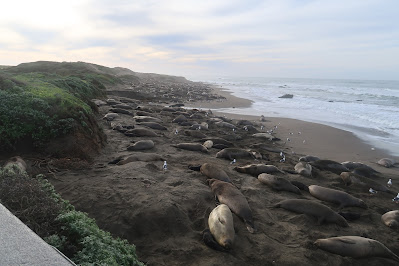
Elephant seal pups born since winter’s storms subsided are doing well at Piedras Blancas beaches. Some are already weaned, others are still to be born. Bulls threaten each other, and occasional battles break out. It’s breeding season at the beach.

Highway 1 is now open north of the elephant seal viewpoint. The parking lot has been graded, but it still has significant potholes. Go slow.

Look for fat, roly-poly pups. After giving birth to 60-80 pound pups, the mothers nurse them for about a month. The pups gain about 200 pounds. Some gain far more. It’s unclear whether this additional weight is a survival advantage. The extra blubber may make them more buoyant in the water, making diving more difficult.

A gull steals milk from this nursing pup.

After they’re weaned, some congregate at the base of the cliffs. They molt their black baby coats and get their first countershaded fur, light on the belly and dark on the back. 

This pup is molting his black natal coat.

As the mothers come to the end of lactation, they come into estrus. They are then ready to mate with the bulls. That’s when the bulls get competitive. Earlier battles were over territory. Now, they battle over breeding rights. 

Look for bulls raising their heads to stare at each other. One or the other will make a move, backing off from a fight. It’s called dominance interaction, displacement. From the viewing area, visitors can see which bull is dominant. 

This bull announces his dominance.

Other beaches

The beaches north of the viewpoint, along the Boucher Trail, are also heavily populated with elephant seal mothers, pups and beachmasters. Park at the lot beyond the viewpoint and walk out.

Few bachelor bulls have come to Hearst Memorial Beach at San Simeon Cove this year. They may have gone to other beaches, such as the north beach at the Piedras Blancas viewpoint and other points north.

Beaches at the northern end of the Piedra Blancas viewpoint were completely inundated repeatedly during high winter tides and atmospheric river storms. That beach is almost exclusively populated by bulls this year.

The north beach at Piedras Blancas

State Parks tours

During this exciting season, February through March, State Parks is offering tours at the Arroyo Laguna beach. Tours are available 9 am on Thursdays, Fridays, and Saturdays. Tickets are $13 per person. Meet at the parking lot, 2.25 miles north of the Hearst Castle Entrance and south of the Piedras Blancas viewpoint. 

Dress for conditions, walking on uneven rocky and sandy ground, possibly muddy. Wear sturdy, close-toed shoes. Dress in warm layers. 

Bring cameras and binoculars. Call 805-776-2564 or check the website for information.

Superbowl ad

The Jeep ad shown during the Superbowl Electric Jeep Boogie Woogie, featured an elephant seal bull backing up rapidly. It’s somewhat enhanced, but visitors may well see bulls doing a similar maneuver, as they confront more dominant bulls.

Who Knew elephant seals would make their way into such rarefied circles!

Saturday, January 21, 2023

King Tide

 I didn't expect to see any pups at the north end of the Piedras Blancas viewpoint, but as I looked over the beach, I heard a pup barking! Despite the high tide, two pups were there. One was safely behind the rocks, but the other was following his mother on the beach.


I hope that one got corraled behind the rocks, where he will have a better chance of surviving. 

The pup behind the rocks appeared secure, but when he went to nurse on the female next to him, she snapped at him. Apparently not his mother! Several  other females are close by, so I'm optimistic he will find his mother, or another accommodating female. With so many pups washed away, there are surplus mothers available.

The King Tide washed over pups and mothers on the south beach, but I didn't see any washed away.


Some pups are confused and seeking any mother to nurse on.


Bulls weren't fighting, and some had found females willing to mate. This male was especially impressive. One of the biggest noses I've ever seeen.


Quite an impressive guy!


Thursday, January 12, 2023

Storms, high tides, wash over elephant seals

Pups are at risk

Winter is birth and breeding season for elephant seals. Weather and King Tides always pose risks, but this season’s storms have been particularly damaging. Many seal pups were washed away as waves inundated the entire beach in parts of the Piedras Blancas rookery.

The elephant seal viewpoint beaches were completely covered by waves during the first set of storms in early January. Nearly all the pups that had been born on the north beach and many on the south were swept away. Watching them struggle was terrible.


The north beach.


                                                                    The south beach.

Both north and south beaches were inundated.

Mothers do their best, but waves often overtake them.


Powerful waves pounded the beach.

This pup found refuge behind rocks, in a pile of kelp.

Jim Mentgen, a Friends of the Elephant Seal docent for four years, watched over the pups for hours over several days.

“I was impressed with how resilient the pups are,” he said. “Even though they were less than a week old, I watched some fight for two or three days against the waves.”

Two of the seven pups he observed survived.

Winter birth season

The first week of January is the beginning of the birthing season. A hundred or so seal pups had been born. More mothers, eventually over 5,000, will come to the rookery, from the lighthouse to a mile south of the viewpoint, to have their pups before the last is born in March.

The waves washed away some of the sand that provided high ground for the seal pups. Less beach is left above high tide line.

At the south end, enough beach is exposed for mothers arriving since the first storm to have their pups. That works until high tides, including King Tides, return January 17-23.

                            Elephant seal mothers and their pups fill the beach above high tide line.

Many mothers have returned to give birth on the beach. They are doing well and their pups are fine. As they nurse and gain weight, they will be better able to overcome high tides later in the month.

This pup is getting fat nursing on his mother. Her belly is pock-marked with cookie cutter shark scars.

Pups need their mothers

Elephant seal pups have some ability to swim when they are born, but they don’t have enough blubber to stay warm and they aren’t able to feed themselves. They can’t survive in the ocean. Just being separated from their mothers can be fatal. Maternal-pup separation is the most frequent cause of pup death.

However, many mothers tolerate nursing pups other than their own. Over 80 percent of pups, even under less severe conditions, nurse on mothers other than their own. The mothers who lost their pups may be willing to adopt orphaned pups.

“In my experience, events like these cause a lot of confusion and mixing of mothers and pups,”  Patrick Robinson, director of the Ano Nuevo Reserve, said in an email.

                                    Pups get separated from their mothers. Whose pup is whose?

Next year’s pups

Whether the loss of pups will affect next year’s birth season remains to be seen.

Elephant seal mothers typically come into estrus and mate about a month after their pups are born. Heather Liwanag, Cal Poly associate professor and principal investigator at the Vertebrate Integrative Physiology lab, expects the bereft mothers to stick around, come into estrus early and mate to get next year’s pup started.

Dr. Robinson has observed mothers do that at Ano Nuevo. “In the past, we have had big swell/tide events with pup loss and the females tend to stay for the duration of the breeding season and mate as usual,” he said.

Dr. Liwanag and her Team Ellie survey the seals on the beach regularly and record their data. “We can estimate losses when we analyze the data at the end of the season,” she said.

Roxanne Beltran, assistant professor of ecology and evolutionary biology at UC Santa Cruz and principal investigator at the BeltranLab studying the seals, is analyzing data on seal pups’ survival from Ano Nuevo’s history of elephant seals, back to the 1960s.

It will take several years to know if this event will cause an appreciable impact on the overall recruitment of the 2023 cohort,” said Dr. Robinson.

Watch the seals on the Friends of the Elephant Seal beach cam.

Highway 1 is open as far as the elephant seal viewpoint. Drive up to visit when the weather clears. The situation is constantly changing.

                                            This beachmaster still reigns over his domain.


Saturday, January 7, 2023

Pups devastated by storm

We drove out after the cyclone bomb storm that hit California last night. Highway 1 was open, sky clearing occasionally, showing sun and blue sky, then clouding up again.


CalTrans closed the highway at the elephant seal parking lot. The parking lot, deeply potholed, was about a third full, more than I’d expected to find on the morning after such a violent storm.


Despite the weather, visitors were there.


At the north end, the entire beach was washed away, inundated by high tide and waves.


A few pups continued to struggle, getting washed out by waves, then taking the respite between sets to make their way up the beach. Frantic mothers were unable to rescue their pups. Terrible to watch.


Much of the south beach was washed away. The raised area I think of as the maternity ward was overwhelmed by wave action.


A few pups near the drainpipe called for help, no mothers within range to help.


The few pups remaining in the central part of the beach sought refuge close to the bluff, but waves tossed them even there.


Mothers did their best to protect their pups.


The high ground was in the dunes. These seals huddled together. 


One newborn was tangled in kelp, unable to free himself. Mothers fretted helplessly.


Check up on the seals in the live webcam, https://elephantseal.org/live-view/


A terrible day. How this loss of pups will affect the population remain to be seen. Normally, mothers nurse for a month, lose about a third of their body weight, come into estrus, mate, and next year's pup gets started. Mothers who have lost their pups msy leve the beach without mating. Whether they will come into estrus and find mates on other beaches isn't known. 


Monday, December 26, 2022

'Tis the season!

Newborn pups in the sand

A few fully mature bulls are on the beach, along with a few pregnant females and a few pups already born. The first pup was born December 10. The second was born December 18, with more following. It’s like popping corn: pop, then pop, then pop pop pop pop pop.


Dominance settles conflict

Elephant seal mothers do an excellent job, under the circumstances. The few mothers who begin the season, with plenty of space around them on the beach, are tempting to young, less dominant males. The attraction is overwhelming, even though the mothers will refuse the males until they come into heat, after they have nursed their pups for a month.

The full-grown beachmasters aren’t imposing discipline on those upstarts yet, but watch for signs of dominance. Although the goal of battling is to establish the dominance hierarchy, once the beachmaster prevails, he can reduce conflict. Just seeing him makes less dominant bulls bustle away.

A young bull approached that first mother and pup, nudging and shoving her around. She got separated from her pup, which can be serious if they aren’t reunited. A pup separated from its mother can lose out on that rich milk, and even die.

The beachmaster rumbled up toward that miscreant, who looked over his shoulder and headed in the other direction. Mother found her pup and all three settled down to a long winter’s nap.

Pups are born night and day


You may be lucky enough to be watching when one is born. Watch for females fussing and tossing a lot of sand. They sometimes toss so much, they build a sort of perch for themselves, with deep ditches dug out on both sides.

Birth starts with a gush of amniotic fluid, as the water breaks.


Wildlife viewing requires patience. Pregnant females will continue to arrive on the beach, into February. Check the live webcam for beach conditions, www.elephantseal.org.

Pups are all black, about three feet long and weigh about 70 pounds when they’re born. They soon plump up on their mothers’ nourishing milk. They’ll nurse for a month. In the last few days of nursing, the mothers mate with one or more males. They wean the pups abruptly when they return to the ocean.

Watch seals from a distance

Bulls that lose out find their way to other local beaches, sometimes called bachelor beaches.

Hearst Memorial Beach at San Simeon Cove attracts them. Human beach visitors may be surprised by a seal among the driftwood.

FES will post guides there for the duration, through March, to advise visitors as to seals they may encounter.

The seals are not aggressive toward humans, but the bulls that come to San Simeon may challenge other bulls to fight on the beach. Human visitors stay safe by giving the seals a wide berth. NOAA Marine LifeViewing Guidelines advise no closer than 50 yards, half a football field. Keep the dog leashed so as not to annoy them. Don’t get between two seals, who may decide to charge each other, or a seal and the water, in case he suddenly decides to go back into the waves.

Informed beach visitors can coexist with the seals. The Piedras Blancas rookery is an example of seals and humans sharing the beach. Stay safe and give the seals time to rest.


Tuesday, December 20, 2022

Welcome back, bulls!

Time to find out who’s the baddest seal on the beach

The first mature bull elephant seal arrived at Piedras Blancas November 15. “He came in with a whisper,” said Cynthia Coulter, a Friends of the Elephant Seal docent who watched him. He’s the harbinger of the breeding season.


The site is free, open all day, plenty of space to accommodate holiday visitors. Come out and see how many of his cousins have joined him.

The biggest and the toughest

Identify bulls by their noses (technically, proboscis), and chest shields. Fully mature bulls have long noses that have a notch across near the top.  When the seal is lying down, the chest shield wraps around the neck to the level of the eyes or further.


Like the nose, the chest shield starts to develop at puberty and continues to expend throughout the rest of their life.  Though males often attack each other’s neck, the chest shield develops whether or not they fight.


Compare noses and chest shields with other seals on the beach. Some are large individuals, but their shorter, smooth noses and less developed chest shields betray their junior status.


Smaller seals are juveniles, still enjoying their fall haul-out rest. They will soon return to the ocean and leave the beach to the breeding seals. They will be at sea, eating and growing, until April and May.


Dominance hierarchy

This first arrival will be ready to take on other bulls to establish the dominance hierarchy. Those relationships govern the beach during the breeding season. The bulls will have settled who bests who by the time the pregnant females begin arriving in December, although it may change as bulls fight through March.

The most dominant bulls, at the top of the hierarchy, are most likely to get to breed, so there’s a lot at stake when bulls fight. It’s not just who won, but who gets the prize.

They recognize each other

Bulls learn which ones they have beaten and which have beaten them. Elephant seal researcher Burney Le Boeuf concludes, “It is clear that they have the mental capacity to remember scores of competitors.” They may look a lot alike to us, but each one is an individual to his competitors.

A bull who loses a fight, even if he has been dominant to others, falls way down the hierarchy. He may be so demoralized that he drops out of the competition for breeding for the rest of the season.


Females arrive in December

The females have been feeding and gestating their offspring since May. The first female usually arrived in early December. Her pup was born December 10, at the far south end of the boardwalk. Follow the crowd!


Thursday, October 20, 2022

Young seals arrive for haul-out

 Respite between migrations

Seals arrive daily on the beach at Piedras Blancas. They are young, not yet breeding age, males and females. It’s the Fall Haul-Out. They’ll continue arriving through October. Most are males. Females mature into breeding age sooner than males, so young females have already joined the adult population.

As quiet as these young seals are at this time of year, they masquerade as simply resting on the beach. That modest demeanor conceals their success at the extremes of life. They are “exceptional, superlative, extremophiles,” says researcher Burney Le Boeuf in his book, Elephant Seals: Pushing the Limits on Land and at Sea.

These seals are resting between their two annual migrations: from April to October, and from November to April. When they leave in November, they will migrate north and west, feeding and growing. They’ll be back in April, time for their annual molt.

Long time, no food

These young seals don’t eat for the four to six weeks they are on the beach during this autumn retreat. They aren’t starving. Their metabolism switches from converting food into energy and blubber to using that blubber to meet their needs for food and water.

The beach is relatively quiet, stirred occasionally by two young males testing their dominance against each other.

Most of the juveniles will return to the ocean, to continue feeding and growing, before the adults take over the beach for breeding season, although some stragglers stay around. Perhaps they are gaining insight into the adult world they will soon join. Adult bulls begin arriving around Thanksgiving for that. Pregnant females arrive soon after. The first pup of the season is typically born in mid- to late December. Mark your calendar.

These young seals are growing into their eventual migration patterns. Males migrate north along the continental shelf, feeding on the bottom. Females migrate to the open ocean, feeding on small fish in the mesopelagic layer. 

On land only briefly

You may see seals holding their breath even while they are sleeping on land. They are accustomed to holding their breath for 20 to 30 minutes in the ocean. They spend 90 percent of their lives at sea, underwater. When they’re out at sea, they come to the surface only for a minute or two to breathe, then dive down again. They withstand the pressure changes from the surface to as much as 5,000 feet, and back up again.

Superheroes!

Other viewpoints

Walk north along the boardwalk, or park in the north parking lot and walk out along the Boucher Trail. It’s about two miles of easy walk, with several additional places to look down on seals on the beach.

The trail leads to the Piedras Blancas Light Station, but to tour that, you have to make a reservation

Notice that the original light is missing from the top of the lighthouse. The light and its Fresnel lens are on display in Cambria, next to the Vets Hall. Lions Pinedorado Foundation, the Coast Guard, the Bureau of Land Management, and the Piedras Blancas Light Station Association are working to preserve the lens and its enclosure, which is rusting out and in danger of collapse. After that is secured, the various groups and agencies will seek a path forward for a better permanent location for the lens.

Local newspaper coverage here.