Sunday, December 8, 2019
Tuesday, December 3, 2019
Bulls arrive at Piedras Blancas
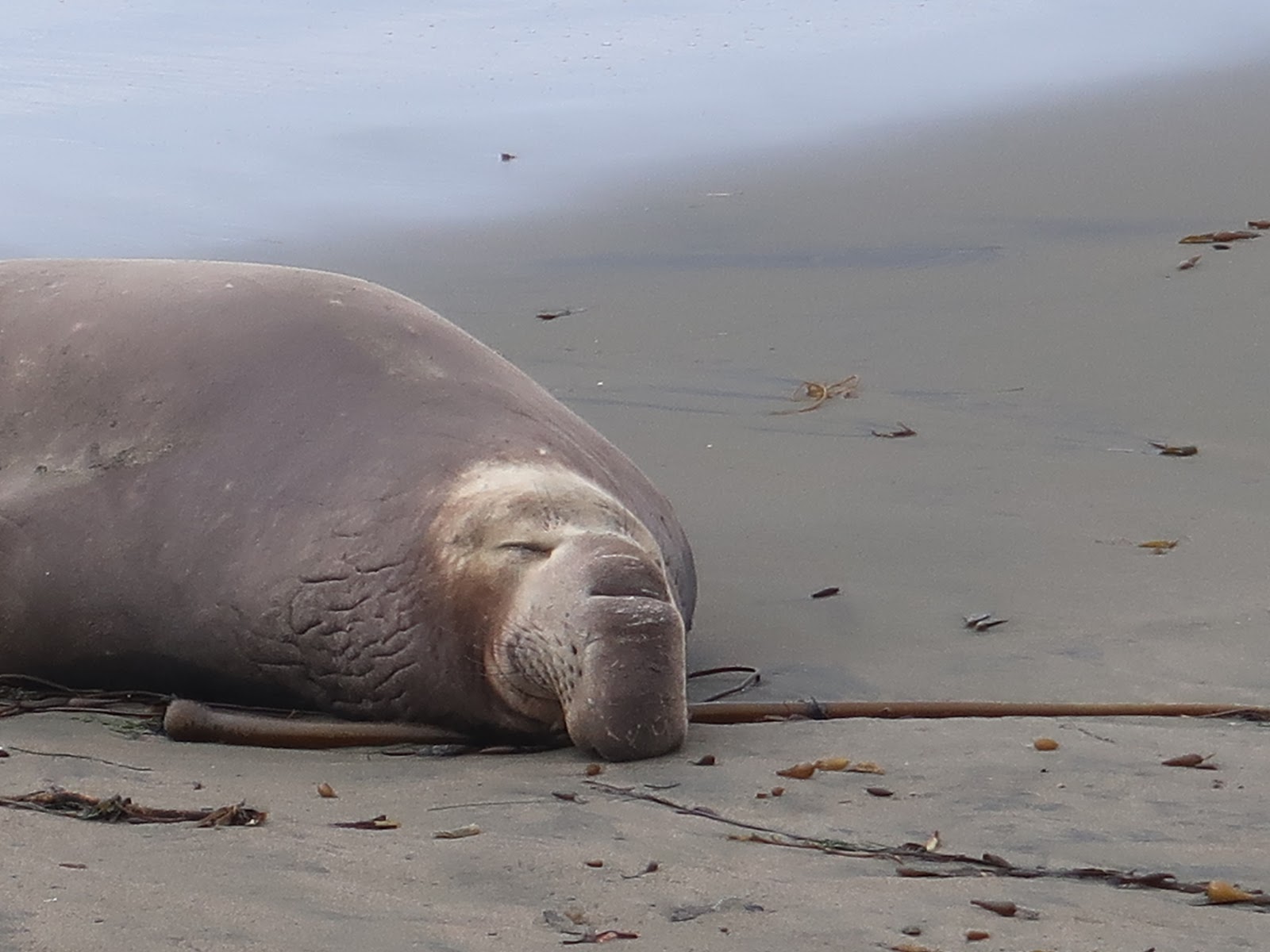
Central Coast visitors during Thanksgiving weekend can count on seeing at least a few full-grown mature bull elephant seals at Piedras Blanca near San Simeon.
The bulls arrive from their northern feeding grounds to stake a claim to the beach. From their sandy vantage above high tide line, they prepare to welcome the pregnant females who will follow in December.
It’s elephant seal birthing and breeding season.
The bulls challenge, and even fight, each other over dominance. Most dominance interactions are resolved without a fight.
One lifts his head and bellows a challenge, or lumbers across the beach to threaten another. The other raises up, willing to fight if necessary, or retreats to fight another day.
The bulls may sense each other’s size from vibrations in the sand, or may size each other up visually.
About 20% of challenges lead to actual fighting.
After they arrive on the beach, they will live off their blubber for as long as 100 days. Fighting takes a lot of energy, which they need to conserve to endure the long fast.
Fights may be resolved by a single strike, or may go on for half an hour.
Eventually, the elephant seals mate. Females come into heat (estrus) and will mate after four weeks of nursing, in January and February.
Dominant male elephant seals known as beachmasters typically have a harem of 30 to 50 females at Piedras Blancas. About 250 bulls come to this rookery.
An elephant seal’s nose — technically, proboscis — starts to grow when the seal is about 5 years old, and continues growing throughout the seal’s life. So nose size is a rough indicator of age for males.
Female elephant seals don’t grow proboscises, resulting in more dog-like faces. Look for longer noses on adult bulls.
Along with big noses, elephant seals develop “chest shields” — thick calloused skin, keratinized with the same material that forms our hair and nails.
The elephant seals rip and tear at those chest shields when they fight, but the thick skin protects them from life-threatening injuries. It bleeds, but it doesn’t tear into open wounds. Look for pink, crinkled skin.
Male elephant seals that lose out in the dominance hierarchy may find solace on other beaches. Some show up in San Simeon Cove, a popular beach for human visitors.
Friends of the Elephant Seal and State Parks have a new volunteer program to help the public stay safe while seals are on the beach.
The seals are legally protected from harassment, which means any kind of human interference.
To become a winter guide and help the seals, register through the Friends of the Elephant Seal website, www.elephantseal.org/docents.htm.
One day of training will be held Saturday, Dec. 7, at Cavalier Plaza in San Simeon. Docents are asked to commit to spending two shifts a month at the cove — 9 a.m. to 1 p.m. and 12:30 p.m. to 4:30 p.m. — mid-December through March.
Contact Friends of the Elephant Seal at 805-924-1628 or fes@elephantseal.org with questions.
Thursday, November 7, 2019
Getting ready for the bulls to arrive
The beach at Piedras Blancas is filling up with young elephant seals. They come onto the sand in the fall for a six-week haul-out.
It’s a chance for the seals to rest between their two annual migrations. When they are out in the ocean, they are not swimming along the surface, or in any kind of straight line. They dive down and come up, dive down and come up, taking two or three minutes at the surface to take a breath, expel the air, and dive down again.
Elephant seals don’t seem to mind the people looking at them from the bluffs. Other species, sea lions and harbor seals, are more wary of humans. They keep their distance, scattering back to the water if people come near. A sea lion or harbor seal that doesn’t retreat when a human approaches is probably sick.
FRIENDS OF ELEPHANT SEALS SEEKING VOLUNTEERS
Elephant seals are different from most other wildlife in that respect. Although they’ve generally avoided beaches used by the public in the past, the number coming to San Simeon Cove during the winter breeding season is increasing. A new program through State Parks and Friends of the Elephant Seals is recruiting volunteers to help keep everyone safe.
The seals coming to San Simeon are less dominant bulls who have lost out in the mating hierarchy. They usually have fought and lost. Some have substantial wounds. They need the beach to recuperate and gather their strength for the next migration and the coming year.
Many visitors who come to San Simeon Cove are unfamiliar with the seals. They may not even recognize a sleeping seal isn’t a rock. Elephant seals usually aren’t aggressive, but it’s not smart to get close to any 5,000-pound animal.
TRAINING PROVIDED FOR NEW GUIDES
The FES Winter Guide program is looking for people who are willing to come to San Simeon Cove and help the public enjoy the beach and the seals safely. After one day of training on Saturday, Dec. 7, docents will work in two shifts, 9 a.m. to 1 p.m. and 12:30 p.m. to 4:30 p.m.
Docents will be stationed at the cove on weekends and holidays from mid-December through March.
Get started by attending one of two public information meetings, at 5:30 p.m. Nov. 13, at the Morro Bay Museum of Natural History, 20 State Park Road; and at 10 a.m. Nov. 16 at Cavalier Plaza, 250 San Simeon Ave., San Simeon. Fill out an application through the Friends of the Elephant Seal website www.elephantseal.org/docents.htm or contact FES at 805-924-1628 or fes@elephantseal.org with questions.
“This is a great opportunity for members of our community to be part of the continued protection, education, and interpretation of these unique and magnificent animals,” State Parks District Superintendent Dan Falat said.
The Central Coast is fortunate to have elephant seals making their home here. We are all neighbors, and can learn to get along.
Christine Heinrichs is a certified California naturalist who writes about wildlife.
From https://www.sanluisobispo.com/news/local/community/cambrian/cambrian-opinion/article236777913.html
Thursday, September 12, 2019
Summer into Fall
Those small seals will someday be as big as the bulls they sleep beside on the beach in August. Juvenile seals are returning to the rookery at Piedras Blancas from their migration for the “Fall Haul-Out.”
Elephant seals have two migrations each year, as far as 5,000 miles each time. The adult bulls have occupied the beach during the summer months, molting their skin and resting. They return to the ocean to forage and gain weight to get them through the breeding season. They will have bulked up with blubber when they return in December.
The young seals showing up on the beach will dominate Piedras Blancas through the fall months then haul out onto the sand and spend six to eight weeks resting.
FIRST-YEAR SURVIVORS
The smallest seals are the “Young of the Year,” the pups that were born during the previous breeding season. Only about half survive the first migration. Those that don’t return were either eaten by predators or unable to catch enough food to survive. These returning seals may be no larger than when they left as weaners, but they have survived. Any seal that arrives on the beach for the haul-out is a survivor.
Even on their first migration, pups are able to dive as deep as 4,000 feet. We don’t know how they find their way north to hunt fish and squid along Canada’s west coast. Some get as far north as the Aleutians, where the adult males feed.
The boardwalks provide excellent viewing for visitors, keeping them safe from the seals and vice versa. Young seals may look cute, but they have sharp teeth and are unpredictable. Even newly weaned pups can give a nasty bite. Think of a 500-pound dog lunging at you. ‘Nuff said.
BEACH SCAVENGERS
The carcass of a dead bull washed up on the beach in August. He didn’t die on the beach, so no one knows what killed him. The turkey vultures and gulls set to work cleaning it up, and it has since been washed away.
Condors have been released in San Simeon. The Piedras Blancas elephant seals could be a food resource for them. Condors are obligate scavengers, meaning they eat only animals that are already dead. They don’t kill anything.
In 2012, when a dead gray whale washed up, condors came from miles around to eat it. At the time, condor biologists weren’t sure where all the condors had gone.
“It was scary,” said Ventana Wildlife Society wildlife biologist Joe Burnett. “They disappeared. We hiked out to find them feeding on the gray whale carcass. They fed on it for six months. It was the party spot. That was the first time anyone witnessed condors feeding on a whale since Lewis and Clark.”
All the San Simeon condors are tagged.
UNITED NATIONS OF PIEDRAS BLANCAS
Summer visitors are international. Overheard conversations sound like the United Nations. The live webcam allows them to show their friends back home the wildlife spectacle of California’s elephant seals. One young visitor from London told me she plans to write a report for school and astonish her classmates.
https://www.sanluisobispo.com/news/local/community/cambrian/cambrian-opinion/article234433417.html
Tuesday, August 27, 2019
Big bulls at rest – or not
Summer on the beach
Summertime, and the living is easy for elephant seal bulls.
They are on the beach, molting their skin. That makes July a great time to
observe some of the finer points of elephant seal appearance and behavior.
Bulls return from their foraging migration in the summer,
plumped up after that 100-day fast during breeding season in the winter.
Gaining a ton or so of blubber is a big job. They’ll fast on the beach for six
weeks or so, living on that blubber. After they finish molting and have their
new skin, they will go back to the ocean to continue foraging until December.
Then they’ll be ready for the breeding season, at top form and top weight, as
much a two and a half tons.
| For bull seals, it's always a good day for a fight. |
Ask a blue-jacketed Friends of the Elephant Seal docent to
show you a sample of shed skin. You’ll see why elephant seals weren’t hunted
for their short, stubbly fur. They don’t have the lush coats of otters and fur
seals, which rely on fur to keep them warm in cold water. Seals have their
blubber for that.
The resting seals give visitors the opportunity to compare
noses and chest shields, important characteristics for bulls. The nose,
(technically, proboscis), and the chest shield, grow throughout a male seal’s maturity,
starting around age five, so they are rough indicators of his age. Bulls can
live to be 13 or 14.
| This group of seals shows the differences between noses and chest shields. |
Look for a pendulous nose with a crease across the top.
Chest shields can extend from the middle of the chest to above eye level.
Younger seals have a smooth nose. The chest shield may be barely visible, just
starting to develop on the seal’s front.
Subtle points, but they are indications of older age among
the seals.
Summer isn’t all R&R for seals. Some pick fights, and
spar across the sand and into the water, but most rest comfortably side by
side. They won’t do that during the breeding season, when they have to be wary
of any rival.
Without females to fight over during the summer, the only
prize is dominance. That may serve them later in the year, when a win will be
remembered and future fights avoided during the breeding season. Better to
conserve their energy for more important things then.
They have earned a few weeks’ rest on the beach. Whether
traveling or feeding, seals are constantly diving. They breathe at the surface
for two or three minutes, then head to 2,000 feet or deeper. It’s not a direct
swim along the surface. Day in and day out, it’s up and down. No wonder they
are snoring in the sand.
Thursday, August 1, 2019
Bulls communicate
June is a month of transition, when
seals of a wide range of ages mix on the beach. Adult bulls are starting to
arrive to join the juvenile seals and adult females that have dominated the
beach since April. The bulls, fat from feeding in the north, now take over the
beach for the summer.
Molting is the annual peel-off of their
hair and top layer of skin. It makes them look ratty, but it’s normal. The old
hair is brown and tattered. The new skin, with newly emerging hair, is pearly
gray.
Males are returning, with some of their
hefty blubber restored after the 100 days they spent without food during the
breeding season. Males feed along the coast of Alaska. They swim north from
Piedras Blancas, covering 60 to 75 miles a day, after the winter breeding
season is over. They mostly forage for bottom-dwelling prey along the
continental slope of Alaska. They return swimming across the ocean, directly to
the California coast.
Adult bulls are among the largest seals,
at up to 5,000 pounds. They are surely dramatic, showing off their prominent
noses and pink chest shields. Their guttural bellows echo against the bluffs.
New research on what their bellowing
means shows that their calls have changed since the 1960s. Pioneering elephant
seal researcher Burney Le Boeuf found the seals at different locations bellowed
at different pulse rates. In effect, they were communicating in different
dialects. That was the first time dialects had been identified in non-human mammal
communication. When UCSC researcher Carolyn Casey re-analyzed Le Boeuf’s
recordings and compared them to new recordings, she found the dialects had
disappeared, but more individual variations had developed.
Geographical dialect may have
disappeared as the population expanded and seals mixed more among beach sites.
But their calls got more complex. Those individualized vocalizations help the
seals know who is who.
Each individual male has his own unique
vocal signature. Each bull knows his adversaries as individuals. They recognize
each other by their calls, and remember who won the battle the last time. That
simplifies seal life, in which dominance is important: No need to fight again.
They’ve settled who won.
Bulls can keep track of 25 to 30 other
bulls that way.
Without these new signatures, “it would
be really difficult to distinguish everyone,” Casey said in an interview with
The Atlantic magazine.
No need to fight during the summer
molting months anyway. As important as it is for bulls to reign as dominant, to
breed with as many females as possible, conserving energy is important, too.
During the breeding season, a bull may go as long as 100 days without food. The
bulls on the beach now are saving the blubber they’ve regained since the
breeding season. They’ll rest on the beach for a few weeks, then return to the
ocean to forage and bulk up even more, for the breeding season that begins in
December.
Look for big, resting bulls on the
beach. That nose, (technically, proboscis), and the chest shield, grow
throughout a male seal’s maturity, starting around age five, so they are rough
indicators of his age. Bulls can live to be 13 or 14. Females can live into
their 20s.
Ask a Friends of the Elephant Seal
docent, a guide in a blue jacket to touch some of the shed skin. They carry
samples to share with the public. Most enjoy handling it, but some prefer only
a cautious touch.
Monday, June 10, 2019
Bulls begin to return
This big guy is the first adult bull to return to Piedras Blancas from the post-breeding migration. Hundreds of young seals and adult females are still on the beach, completing their molt.
He's restored some of his hefty blubber, after the rigorous breeding season fast. He may have gone 100 days without food during the breeding season.
Males feed along the coast of Alaska. They swim north from Piedras Blancas,
covering 60 to 75 miles a day, after the winter breeding season is over. They
mostly forage for prey on the bottom.
Subscribe to:
Posts (Atom)