Monday, February 21, 2011

First molt

All elephant seal pups are born with black coats, slightly curly. That's replaced in their first molt, after they are weaned. They get a brown and tan coat, more like the adults, dark on top and light underneath. It's a usual marine camouflage, making them blend into the background for predators. Their dark backs blend into the dark abyss for predators looking down on them from above, their light bellies into the bright surface for predators looking up at them from below.
This one shows the patches of dark skin peeling off, showing the brown coat beneath.
The black coat is also an indicator of maturity to Marine Mammal Center rescuers. Pups rescued before they molt get formula.

Monday, February 7, 2011

Black coat weaners

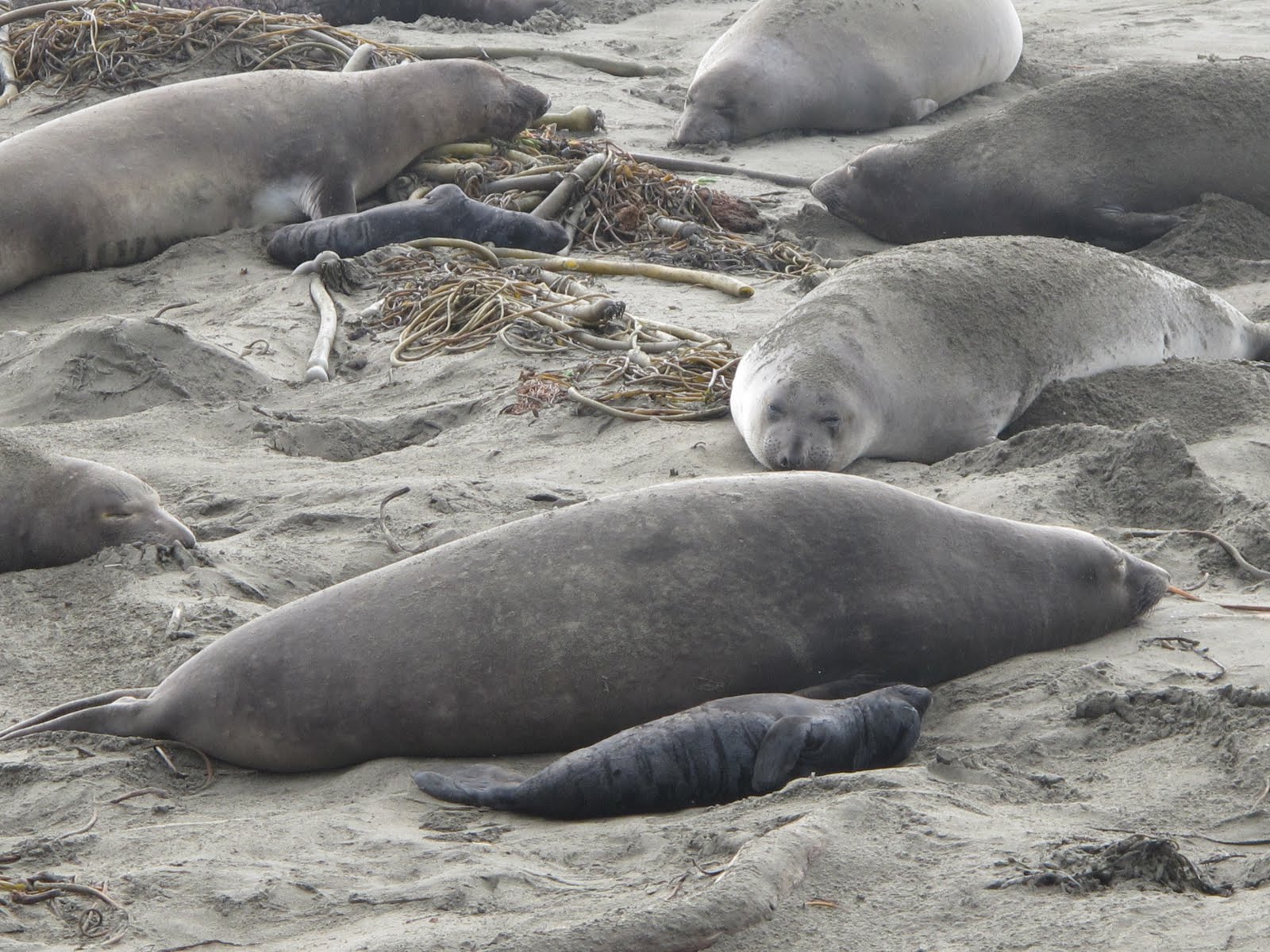
Elephant seal pups are born with a solid black coat, unlike the brown coat with a light belly and dark back they will acquire. They molt that dark wavy coat after they are weaned. That's the condition of this fat weaner enjoying the sun today on the beach.

The black coat is technically considered lanugo, a preliminary coat. Even humans have a lanugo stage during fetal development. Elephant seals keep theirs after they are born.

The black skin peels off, revealing a silvery coat. Marianne Riedman in her book on The Pinnipeds reports that males molt later than females, so perhaps this one is a female. It's hard to tell with youngsters. Females also get teeth sooner than their brothers.

Friday, February 4, 2011

Elephant seal daycare

On Monday, I stopped at Hearst Beach, San Simeon Cove on my way up to the bluff. That’s where the man was attacked last month. State Parks has asked for volunteers to spend time there, to educate the public about the seals that are increasingly resting there.

Ranger Jose Lopez happened to arrive at the same time I did, so I joined him in driving down the beach to see how many were there. We counted seven adult seals on the beach.
He honked at them. They sure don’t like the truck. Several roused themselves as the truck drove past and a couple opened their mouths. I’m not sure whether it was a threat or not. I was glad I was in the truck and not on foot! How terrifying it would be to be attacked.

That wildlife/human interface is always troublesome.

At the Piedras Blancas bluff, thousands of seals are doing well. Many youngsters have already been weaned and are on their own. Some are still being born. I saw several newborns on the beach, although I didn’t witness any births that day.

These two mothers have attracted 11 pups! It made me wonder if there is any kind of reciprocal caring going on. Cows babysit for each other. I’ve never heard it described, but elephant seal mothering is far from completely understood. This looks like elephant seal daycare.

Thursday, January 20, 2011

Man bitten by elephant seal

A man who was chasing people away from an adult male elephant seal got between the seal and the ocean and was attcked and bitten during the first week of January, http://www.sanluisobispo.com/2011/01/20/1449415/seal-bites-man-at-san-simeon.html. The seal was resting on the beach at San Simeon Cove, like this one I photographed January 10. In the distance, a rider on horseback is towing a surfer on a surfboard. The seal is more than twice as large as the horse.
The close encounters between humans and seals make attacks more likely. A subadult male was reported at Leffingwell Landing in Cambria in early January and many seals have made Arroyo Laguna their destination during the breeding season. Last year quite a few pups were born there. Only a conventional gate in the fence separates the public from the field. Visitors open it and walk among the seals. I watched two adults with two young children walking in the field January 17.
It's a worrisome situation. No one wants anyone to get hurt. The docent program at Piedras Blancas is the best defense against seal attacks. By educating the public, fewer will venture within biting range and both sides can remain safe.

Tuesday, January 11, 2011

Maternity Ward

This newborn reaches up to nurse. Weighing in at 65-80 pounds ata birth, pups gain as much as ten pounds a day for the month that they nurse.

Elephant seal milk can be as much as 63 percent fat. The fat content rises as lactation proceeds over the month of lactation. The mother fasts during the entire time. Water produced for milk must be produced metabolically. She conserves her own reserves by producing less dilute milk.

Marianne Riedman studied elephant seal milk and found herself so attracted to its creamy white color, "like rich vanilla ice cream," that she couldn't resist tasting it.

"The milk did not taste like ice cream or anything else I had eaten before," she reports in The Pinnipeds. "It had no sweetness but rather a nutty blandness and a waxy texture, probably due to its abundant fat."

Her milk collection method is as intrepid as you would imagine it would need to be. After all, how do you get milk from an elephant seal? The temptation is to say, Very carefully, but it's more complicated than that.

She cobbled together a vacuum system made from an old fire extinguisher, which she strapped to her back. She operated the vacuum by pressing valves with her hand. With a funnel attached to the end of a nine-foot pole, connected to vacuum tubing and a small container for the milk, she'd sneak up on a nursing mother and maneuver the funnel over the teat. A few quick sucks were usually all she could get before the mother noticed that it wasn't a pup sucking on her.

"Enraged, she would invariably hiss threateningly or charge me, prompting me to retreat quickly to a safer location," she writes.

Anything for science!

Monday, January 3, 2011

Births gather momentum

Plenty of pups have been born on the beach, with more to come.

Mothers and pups continue to experience some confusion. One visitor said she'd like to make little hats for the pups, so their mothers would recognize them. She was very concerned, but as we stood and watched for half an hour, one of the mothers woke up and took an interest in her pup. By that time, another mother had assumed some protective feelings for the neglected little one, but after some fussing, they settled down, one to one.


After days of rain, today was sunny and pleasant. This little fellow appears to be enjoying the respite from being drenched.

Tuesday, December 28, 2010

Newborn confusion

Mothers and pups sometimes get confused on the beach. It happened Monday, when three mothers contended over four pups. None of the visitors witnessed the births, so we observers were as confused as the seals.

My guess was that the missing mother was about ten feet away. A female was sleeping just beyond the group. The large reddish spot on the sand suggested that a birth had recently happened there, and she was the likely mother.

Two of the mothers barked and threatened each other. The third quietly tended to two pups. The bright sunshine causes sharp shadows that make this photo difficult to decipher. Here one of the mothers barks at a pup, while her rival tosses sand on her back.

All four of the pups were very new, and I didn't see any of them nursing. The two pups affiliating with the quiet mother were sociable toward each other, nosing each other companionably.

The beach isn't terribly crowded yet, but this group managed to get their signals crossed. I don't know whether anyone has every documented switched pups. It seems like something that could happen, without ill effects. So long as a pup gets care and adequate milk, it wouldn't be important that it be from its biological mother. Last year lots of mothers nursed other pups after theirs died in winter storms.

We'll see how the season progresses. Few females have chosen to settle on the north end of the rookery, where the beach has eroded.