Tuesday, December 20, 2022

Welcome back, bulls!

Time to find out who’s the baddest seal on the beach

The first mature bull elephant seal arrived at Piedras Blancas November 15. “He came in with a whisper,” said Cynthia Coulter, a Friends of the Elephant Seal docent who watched him. He’s the harbinger of the breeding season.


The site is free, open all day, plenty of space to accommodate holiday visitors. Come out and see how many of his cousins have joined him.

The biggest and the toughest

Identify bulls by their noses (technically, proboscis), and chest shields. Fully mature bulls have long noses that have a notch across near the top.  When the seal is lying down, the chest shield wraps around the neck to the level of the eyes or further.


Like the nose, the chest shield starts to develop at puberty and continues to expend throughout the rest of their life.  Though males often attack each other’s neck, the chest shield develops whether or not they fight.


Compare noses and chest shields with other seals on the beach. Some are large individuals, but their shorter, smooth noses and less developed chest shields betray their junior status.


Smaller seals are juveniles, still enjoying their fall haul-out rest. They will soon return to the ocean and leave the beach to the breeding seals. They will be at sea, eating and growing, until April and May.


Dominance hierarchy

This first arrival will be ready to take on other bulls to establish the dominance hierarchy. Those relationships govern the beach during the breeding season. The bulls will have settled who bests who by the time the pregnant females begin arriving in December, although it may change as bulls fight through March.

The most dominant bulls, at the top of the hierarchy, are most likely to get to breed, so there’s a lot at stake when bulls fight. It’s not just who won, but who gets the prize.

They recognize each other

Bulls learn which ones they have beaten and which have beaten them. Elephant seal researcher Burney Le Boeuf concludes, “It is clear that they have the mental capacity to remember scores of competitors.” They may look a lot alike to us, but each one is an individual to his competitors.

A bull who loses a fight, even if he has been dominant to others, falls way down the hierarchy. He may be so demoralized that he drops out of the competition for breeding for the rest of the season.


Females arrive in December

The females have been feeding and gestating their offspring since May. The first female usually arrived in early December. Her pup was born December 10, at the far south end of the boardwalk. Follow the crowd!


Thursday, October 20, 2022

Young seals arrive for haul-out

 Respite between migrations

Seals arrive daily on the beach at Piedras Blancas. They are young, not yet breeding age, males and females. It’s the Fall Haul-Out. They’ll continue arriving through October. Most are males. Females mature into breeding age sooner than males, so young females have already joined the adult population.

As quiet as these young seals are at this time of year, they masquerade as simply resting on the beach. That modest demeanor conceals their success at the extremes of life. They are “exceptional, superlative, extremophiles,” says researcher Burney Le Boeuf in his book, Elephant Seals: Pushing the Limits on Land and at Sea.

These seals are resting between their two annual migrations: from April to October, and from November to April. When they leave in November, they will migrate north and west, feeding and growing. They’ll be back in April, time for their annual molt.

Long time, no food

These young seals don’t eat for the four to six weeks they are on the beach during this autumn retreat. They aren’t starving. Their metabolism switches from converting food into energy and blubber to using that blubber to meet their needs for food and water.

The beach is relatively quiet, stirred occasionally by two young males testing their dominance against each other.

Most of the juveniles will return to the ocean, to continue feeding and growing, before the adults take over the beach for breeding season, although some stragglers stay around. Perhaps they are gaining insight into the adult world they will soon join. Adult bulls begin arriving around Thanksgiving for that. Pregnant females arrive soon after. The first pup of the season is typically born in mid- to late December. Mark your calendar.

These young seals are growing into their eventual migration patterns. Males migrate north along the continental shelf, feeding on the bottom. Females migrate to the open ocean, feeding on small fish in the mesopelagic layer. 

On land only briefly

You may see seals holding their breath even while they are sleeping on land. They are accustomed to holding their breath for 20 to 30 minutes in the ocean. They spend 90 percent of their lives at sea, underwater. When they’re out at sea, they come to the surface only for a minute or two to breathe, then dive down again. They withstand the pressure changes from the surface to as much as 5,000 feet, and back up again.

Superheroes!

Other viewpoints

Walk north along the boardwalk, or park in the north parking lot and walk out along the Boucher Trail. It’s about two miles of easy walk, with several additional places to look down on seals on the beach.

The trail leads to the Piedras Blancas Light Station, but to tour that, you have to make a reservation

Notice that the original light is missing from the top of the lighthouse. The light and its Fresnel lens are on display in Cambria, next to the Vets Hall. Lions Pinedorado Foundation, the Coast Guard, the Bureau of Land Management, and the Piedras Blancas Light Station Association are working to preserve the lens and its enclosure, which is rusting out and in danger of collapse. After that is secured, the various groups and agencies will seek a path forward for a better permanent location for the lens.

Local newspaper coverage here.  


Thursday, September 22, 2022

Predators patrol offshore


Young elephant seals make a good blubber meal

A local photographer documented orcas offshore theCentral Coast in September. Orca sightings are unusual, although the fact that they are there is not unexpected.

Orcas are known to prey on elephant seals, although it’s not well documented. This happens far at sea, with no humans around to watch.

September is when juvenile elephant seals return to Central Coast beaches. They come to take a month or so of rest, the Fall Haul-Out. Hundreds of them sleep on the beach at Piedras Blancas. Look for size differences, nose development, and scars from prey attacks.


Predators feed on young seals

Great white sharks prey on the juveniles in the Farallon Islands and Tomales Bay in the fall. Perhaps these orcas were here to do the same.

Vincent Shay, the photographer, identified two groups of orcas: one group of four and the other of five. They were likely transient orcas, which feed on marine mammals. 

According to Port Townsend Marine Science Center at Fort Worden State Park, “transients travel and hunt in small groups of 2-6 individuals. These small groups are usually based on a female and her offspring, but often change as animals mature and disperse.”

Evading predators

Elephant seals dive deep, but predators can attack when they come to the surface to breathe. Staying in the dark depths is safer. They feed below their predators’ usual hunting depths. Even traveling between their feeding sites and the rookery, the seals travel in long v-shaped dives, as far as possible below the range of their predators. Researchers call it “the lightscape of fear.”


Sharks and orcas hunt at relatively shallow depths. Orcas are also intelligent and have complex social structures. They hunt cooperatively in groups.

Sharks know when they are outclassed, though. They clear out when orcas swim through. One study found that when orcas showed up in the Farallons, sharks hunting elephant seals relocated to Ano Nuevo and other shark aggregation sites.

At Piedras Blancas in September, seals rest peacefully on the beach, waking up for the occasional match with another young seal. Each one is a survivor of the dangers they face from predators even more fierce than they are.

San Simeon Cove Winter Guides

December through March is elephant seal breeding season. Piedras Blancas rookery is the main local breeding area, but alpha bulls chase less dominant males off those beaches. They often come to San Simeon Cove to rest and recuperate from their battle wounds.


Human visitors and their dogs also come to the cove. The seals are an unexpected wildlife experience for them. Friends of the Elephant Seal guides help to keep both sides safe.

The bulls that come to San Simeon Cove are less dominant only to other, even bigger bulls. They weigh two tons or more. While they are rarely aggressive toward beachgoers, they can be dangerous. Visitors need to keep their dogs from annoying the seals, and stay well back. Seals may challenge each other, or decide to return to the ocean without warning to visitors strolling down the beach.

FES trains volunteers to educate the public and help everyone enjoy visiting the beach. Join them by applying online by October 17. Questions? Call 805-924-1628. Must be 18 or older. Commit to two four-hour shifts a month, December through March. Must be friendly, outgoing, able to stand for three to four hours and walk on the beach in a variety of weather conditions.

https://www.sanluisobispo.com/news/local/environment/article266192816.html


Thursday, August 25, 2022

Beachmasters dominate their domain

 Get a close-up look at the big bulls

August is a good time to look closely at elephant seal bulls at Piedras Blancas. They have conveniently placed themselves near the visitor entrance at the north end of the parking lot.

A few juveniles are early arrivals for the Fall Haul-Out, their annual rest before the adults take over the beach for winter breeding season.

The smallest are the Young of the Year, last winter’s pups. Those who have survived return to the beach from their first migration. Only about half survive, so every young seal who is on the beach has already passed a major hurdle on the way to adulthood. They still look perfect, their skin smooth and unscarred.


Fine points of dominance

Only males grow the trunk-like nose, technically proboscis. It starts growing when the seal is about five years old, and continues throughout its life. Nose size is a relative indicator of age.

The other visible indicator is the chest shield, the pink skin on that blubbery chest. It starts as a roughness or puckering of the skin and grows along with the nose. Fully mature bulls have a chest shield that is level with their eyes. Now, that’s a beachmaster!


The adult bulls will leave the beach soon, to continue feeding and gaining blubber. They need to be at their physical peak for the breeding season. They will return in November and December for the duration, about 100 days.

Countershading

Several visitors this week asked about the light-colored bellies on seals sleeping on their backs. It’s a common ocean camouflage. Predators swimming below them see the light belly blending with the bright surface above. Those swimming above the seal see the dark back blending into the dark depths.

Poop

Several recent visitors were vitally interested in elephant seal poop. Seals rarely poop on the beach – thank goodness, we wouldn’t be standing mere feet above them if they did! The smell would be overwhelming.

As the seals leave their foraging grounds up north to return to the beach, they eat only prey that happens into their path. They poop out most of what they’ve digested along the way. What’s left is the remains of red blood cells being recycled during that fast. The result is bright orange liquid poop.

It's not an established fact, but I’ve occasionally observed seals poop out an orange cloud just before they surf out onto the sand. Thank you!

Young seals

Some of the small seals are juveniles, two or three years old. Young males and females look very much alike. Around age five, males begin growing that nose, and getting bigger than females.


They are the early arrivals for the Fall Haul-Out, six weeks or so of rest. The young seals migrate along the same routes as their elders, although they don’t go as far as the other adults until their third or fourth migration.

They are diving and feeding almost constantly, more than 20 hours a day.

They arrive and depart individually, so young seals will be on the beach through the end of November, and perhaps beyond.

https://www.sanluisobispo.com/news/local/environment/article264691139.html


Friday, July 29, 2022

Bull molting season

 Fewer but bigger seals on the beach

It’s bull seals’ turn to take over the beach. They are here to rest and shed their skin in July and August, the annual molt.

Summer marks the conclusion of the short post-breeding migration. The seals on the beach are mostly pretty good size, but they will get a lot bigger during the long migration, from August to November.

Catastrophic molt

All elephant seals molt their skin once a year. Female seals and juveniles were on the beach in May and June. They have returned to the ocean, leaving the beach to the bigger males.

This group of elephant seal bulls looks ratty, but they are just molting their skin. Note the crease beginning to develop in the nose of the seal in the center, indicating that he is six to seven years old. (Christine Heinrichs photo)

Last year’s brown and tan skin, actually a layer of keratin, peels off in chunks, taking the hair with it. Beneath it is a pearly gray or silver coat. They look terrible, but it’s normal. Back in the 1960s, before locals recognized the seals, a resident who saw one called the police to report this sickly seal. An officer came out and agreed that it looked bad, and shot it to put it out of its misery. Burney LeBoeuf recounts the incident in his book, Elephant Seals: Pushing the limits on land and at sea.  “Of course, the seal was fine; it was just molting.”

Ask a blue-jacketed Friends of the Elephant Seal docent to see and touch a sample. It’s rough, not soft and silky, like otter or fur seal fur. Elephant seals rely on their blubber for warmth, not their fur.

Seals spend an average of 32 days on the beach to molt. They arrive and leave individually over the summer months. Seals are solitary at sea. Every seal for himself.

Adults and youngsters

The seals currently on the beach are mostly subadults, about six years and older, and fully adult males, eight years and older. The size of the nose is a rough indicator of age. It starts growing when the seal is about five, and continues throughout its life. A few juveniles, and even some of last year’s pups, now called young of the year, find places to rest among their much larger cousins.


Sleeping in the sand

Notice that seals sleeping on their sides breathe only through the nostril that is on the opposite side from the sand. It’s a reflex behavior, shutting the nostril close to the sand to avoid inhaling sand. This ability to close one nostril independent of the other may be related to their adaptation to deep diving under high pressure.

Navigation

Exactly how elephant seals navigate their migration, as far as 5,000 miles, isn’t known. Experiments that took seals about 40 miles from their home rookery showed they found their way back in a couple of days. Tracked during their dives, the researchers found that even as seals drifted downward on their dives, spiraling as many as 20 times, they headed in their original direction when they got back to the surface.

Since they are underwater most of the time, whatever clues beckon them on their way must be ones that they can discern underwater. That could include acoustics (sound), geomagnetism, and visual clues from the shoreline.

I wonder if they look for Davidson Seamount and Morro Rock. What does their underwater world look like to them?  


Friday, June 24, 2022

Bulls return


Females, young seals gradually leave the beach

An other-worldly moan rises from the beach, warbling on the crisp wind. It’s a female elephant seal at Piedras Blancas. If it weren’t such a bright sunny day, I’d be creeped out.

Female seals usually bark, unlike the belching bellow of the males. But they are capable of variations on their vocal theme. Those yodels must mean something to them, as yet undeciphered by their human observers.

The crowd disperses

Most seals have vacated the south beach, but the seals still crowd the north end of the viewpoint. The adult females and juveniles of both sexes who are concluding their molt take little notice, but adult bulls are arriving, one by one. Soon they will dominate the beach.

It’s the usual summer transition. Time for the juveniles to return to the ocean for a few months. They’ll return in the fall for a few weeks rest, then spend the winter at sea, leaving the beach to the breeding seals.

Pregnant females

The females came into heat as they stopped nursing last season’s pups. They mated and the next pup got started, but in a process called delayed implantation, the embryo stopped developing after a few cell divisions. The females returned to the ocean for their annual short migration, from February or so to May.

That gives them a chance to regain some of the blubber they lost while nursing their pups. They stay on the beach with their pups during the birth and breeding season, not eating. They lose about a third of their body weight.

Adult females leave to spend the next seven months feeding at sea. They are pregnant with the next generation, and will return in winter to give birth.

Return of the bulls

Bulls are returning. It’s their turn to have the beach to themselves in July and August, while they molt their skin. The old brown and tan skin peels off in chunks, revealing the new skin underneath. New hairs are just beginning to grow, making the skin gray. As the hair grows, the color becomes brown.

The upper layer of skin is new, but old scars remain.

These two bulls are companionable on the beach during the summer molt. (Christine Heinrichs photo)

The adult bulls are the ones with the trunk-like nose that gives them their name. The nose, technically proboscis, and the chest shield, begin growing at puberty, when the seal is about five years old. They grow throughout the seal’s life, so chest shield and nose size are relative indicators of age.

Bulls don’t fight much during the summer. They may bellow at each other occasionally, but flipping sand is about the most activity on the beach in June. It’s a good time for summer visitors to observe them at rest.

This senior bull, with a large nose and chest shield, eyes the two younger ones sparring in the surf. (Christine Heinrichs photo)

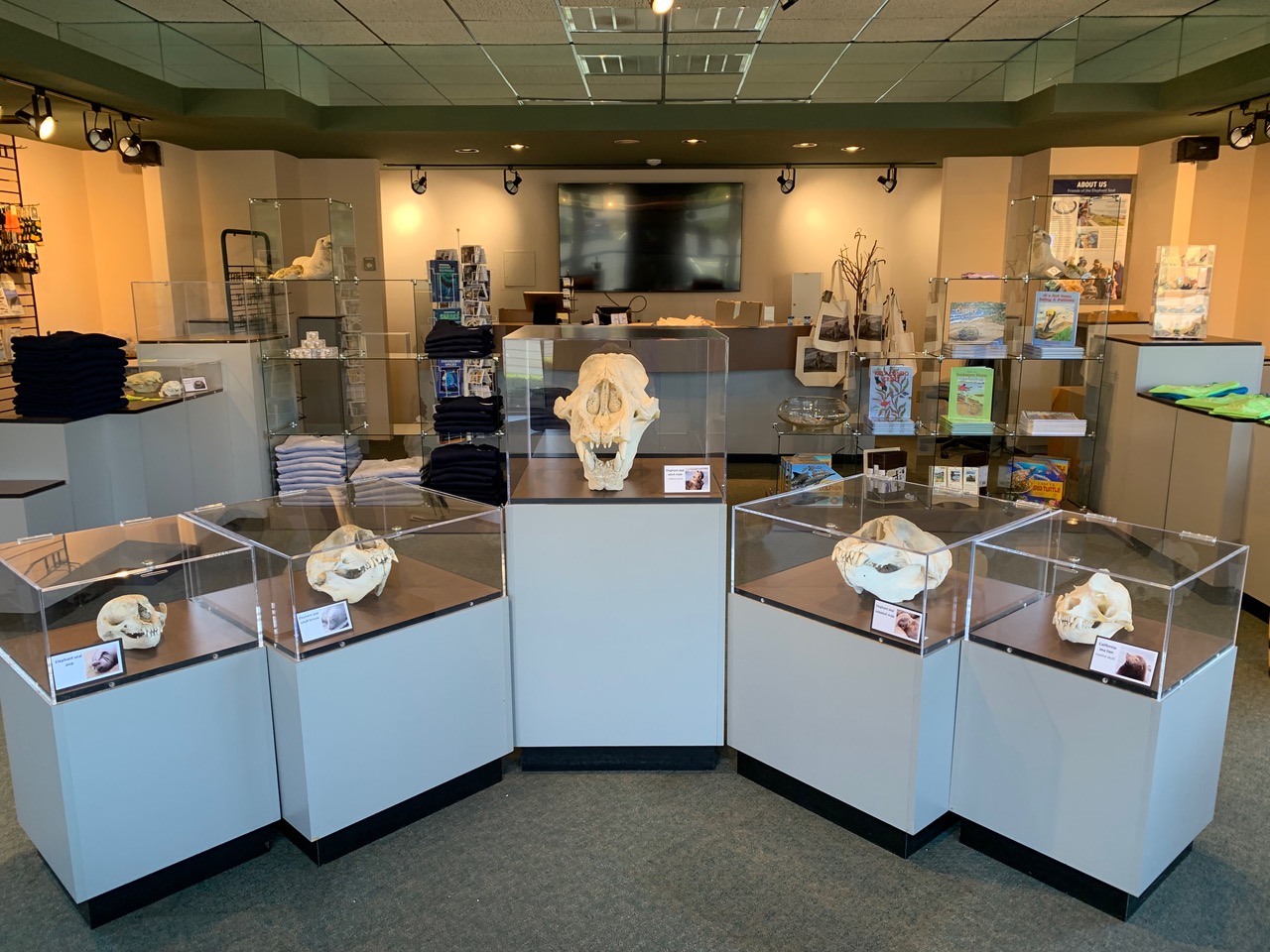
Elephant Seal Visitor Center

Friends of the Elephant Seal celebrates the grand opening of its new, expanded visitor center in Cavalier Plaza, 250 San Simeon Avenue in San Simeon on July 16. Starting at 11 am, they’ll have a program of research and educational presentations, children’s story time, book signings, a Seal Science exhibit, new exhibits on how blubber keeps seals warm, seal anatomy, diet, and local predators. Guides will be available to answer questions. State Parks staff will lead a guided walk along the Boucher Trail, north of the viewpoint, which overlooks several more elephant seal beaches.

The center is open for visitors daily 10 am-4 pm. https://elephantseal.org/july16/


Friday, May 27, 2022

Welcome back!


Adult females and all juveniles return to the beach

More seals are on the beach in May at the Piedras Blancas elephant seal viewpoint than any other time of the year. Adult females, returned from their short migration, sleep. Juveniles, both male and female, have been out to sea all winter. They now fill out the beach crowd. Young males spar while their elders take advantage of the time to rest and all molt their skin.

Researchers marked M 92 and watched her give birth to her pup. They observed them until the pup was weaned. Then the pup got two white tags, so his appearance can be tracked. (Christine Heinrichs photo) 

Molting

The obvious change the seals undergo is molting their skin. The old brown skin and hair peels off in chunks, exposing new skin and hair underneath. Look for pearly gray seals next to brown and tan seals. Check out the ones with skin curling off around eyes and nose. Old scars also start peeling back the molted skin.

The process carries its own distinctive aroma, from all those mammals shedding skin on the beach. A few of the less thoughtful have orange feces smeared on their back ends.

Good thing the seals don’t defecate on the beach, or the smell would chase visitors off the boardwalk. It’s just a few outliers who add to the smell.

The seals stop foraging for food a day or two before they arrive, and don’t eat anything while they are on the beach. Their digestive and metabolic processes change. My observation is that arriving seals often defecate just before they arrive on the beach, leaving an orange bloom behind them.

Female migration

The females are undergoing changes as the egg that was fertilized back during the breeding season now implants in the uterine wall and begins to develop into an embryo. The process is called delayed implantation. After fertilization, the egg divides a few times and then pauses.

The process gives the mother time to restore her weight so that she is strong enough to carry the pregnancy to term.

Starting now, gestation takes about eight months. The females will leave the beach in a month or so. They will return in January, after their long migration, to have their pups.

Look for marks, other species

With research projects ramping up at Cal Poly and other locations adding marks, marked seals are more commonly seen on the beach. All marks are temporary, since they come off with the molted skin.

Other wildlife share the beach. A Guadalupe fur seal pup and a California sea lion pup hauled out on the beach recently. Every day brings different animals and birds to the viewpoint. The elephant seal viewpoint is easy to access but provides world-class wildlife viewing.

Monterey Bay National Marine Sanctuary is one of 15 that protect seascapes, wildlife and maritime heritage resources. Save Spectacular is the theme of the 50th anniversary.  (Douglas Croft photo NOAA)

The beach is within Monterey Bay National Marine Sanctuary. To celebrate 50 years of national marine sanctuaries, NOAA has compiled a series of Resource Collections. Peruse the many events, photos, lesson plans, maps, and other educational materials at https://sanctuaries.noaa.gov/50/?utm_medium=email&utm_source=GovDelivery. One covers Ocean Sound and Impact of Noise, https://sanctuaries.noaa.gov/education/teachers/ocean-sound/. The SanctSound Monitoring Project offers a portal that provides downloadable tools for comparing ocean sound, with six tutorials to help use the data.