Tuesday, June 22, 2021

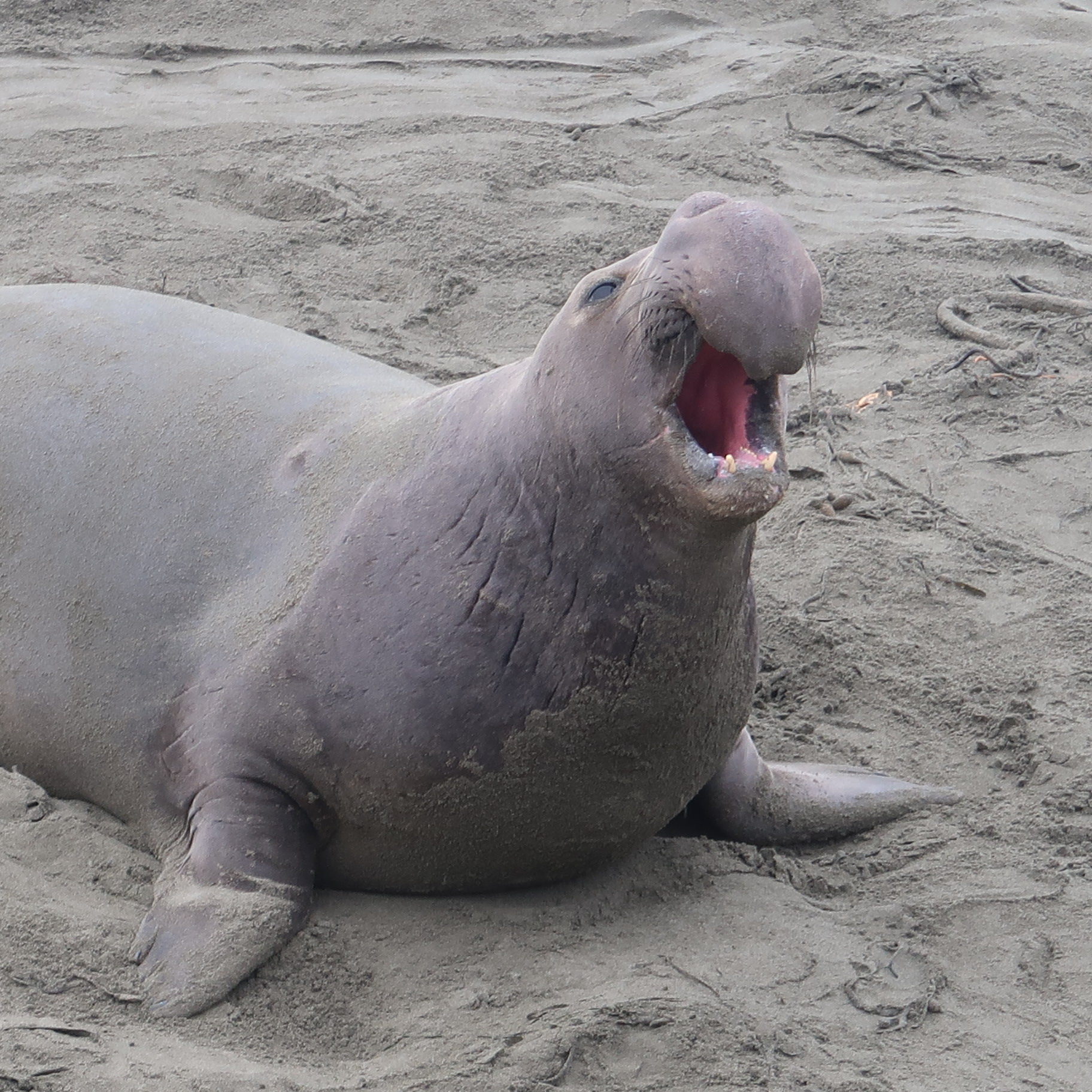
Here come the bulls!

Seals in transition

Females and youngsters give way to bulls

Adult female seals and male and female juveniles occupy the beach through June. Mature bulls start arriving for their summer molt.

Elephant seals are migratory, so they are always coming and going. Summer marks the conclusion of the females’ short migration. As they leave, they embark on their long migration. The females won’t return until January, when they come to the beach to have their pups. Juveniles return in the fall.

Gestation

The adult females mated last winter, after they weaned their pups. That got the next pregnancy started by fertilizing the egg, but after that, development pauses.  The fertilized ovum makes only a few cell divisions and then stops developing, before it is ready to implant in the uterus.

Thin from nursing the pups for a month without eating, the mothers need to return to the ocean to add blubber before the fetus starts requiring nourishment. Recent research shows that they feed 20 to 24 hours a day during that two-month migration. They may travel as far as 3,700 miles.


They dive continuously, down to 1,600-5,000 feet, 20 minutes or so down and back, taking a two- to three-minute breath at the surface before making the next dive.

When the “slightly pregnant” females get back to the beach, they stop eating. Their skin starts to peel off, molting. During the molt, a surge of hormones causes the egg to resume developing and to attach to the uterus wall, beginning active gestation. It’s called delayed implantation.

There’s 11 months between mating and birth, but actual gestation is only eight months.

Feeding

The seals need to spend most of the time feeding, because they are eating small fish, most less than three inches long. They take 1,000 to 2,000 bites a day, snapping up small fish. It’s difficult, but few other predators compete with them for those abundant fish in what’s called the mesopelagic layer.

Those little fish, all together, dominate total fish biomass in the ocean. Female elephant seals evolved a feeding strategy that allows them access to lots of food that few other animals hunt. It’s a unique ecological niche.

The downside is that spending so much time feeding leaves little time for anything else, such as sleeping. Sleep among elephant seals is not well understood. They rest, and may sleep, on some of their dives, rolling onto their backs after they get deep enough and drifting back and forth like falling leaves. The seals sleep or rest less than an hour and a half a day.

Climate change

That mesopelagic layer of billions of little fish is being affected by climate change due to greenhouse gases. Changes there would be reflected in the elephant seals’ well-being.

“Elephant seals can be used as sentinels to better understand how rapid climate change alters the little-known but ecologically important mesopelagic ecosystem,” researchers concluded in their study, Forced into an ecological corner: Round-the-clock deep foraging on small prey by elephant seals.  


Monday, May 24, 2021

Skin molt

 All seals, all the time

Molting seals shed their skin

The Piedras Blancas elephant seal beaches are full of seals in May. It’s the busiest time of the year. All the females who had pups during the breeding season are back, along with all the male and female seals who are not yet fully mature.

Of the full herd, only this year’s pups and the mature bulls are not on the beach. They are on their migration, feeding before they return later in the summer and fall.

Feeding during the short migration

The females are looking good, fat from two months of feeding in the open ocean. Recent research showed that these seals, who departed in February thin from not eating during the breeding season, spend almost all their time after they leave the beach feeding. They average less than an hour and a half of sleep every day, diving constantly to devour enough fish to gain the weight they need.

Using electronic technology to measure jaw movements and record video of what the seals were eating, the researchers found the females relied on small fish in the open ocean. They dove to 1,300-2,000 feet, a zone where these small fish, which in total comprise most of the ocean’s fish biomass, are plentiful. The females snap their jaws between 1,000 and 2,000 times a day, to catch fish that weigh less than half an ounce.

These female seals are the only large animals down there, feeding on these fish. The males are simply too big to make a living on small fish, so they stay closer to the coast and hunt bigger prey on the ocean floor.

The downside is that it takes all day, every day, for these half-ton seals to eat enough to make up for the weight they lost during that month or more they spent on the beach, giving birth and nursing their pups.

The research was based on the Ano Nuevo colony. The research team includes Patrick Robinson, director of the Ano Nuevo Reserve, and UC Santa Cruz assistant professor Roxanne Beltran, who will discuss their work in the future at a public event in Cambria.

Molting

They return, with that sleek load of blubber, in May. They molt their skin, which we can see. What we can’t see is that their bodies are changing internally, preparing for the next pup to be born next winter.


This annual event gives them new skin to face the coming year. You can see the difference between the old, brown skin and the pearly gray new skin. As the hairs grow, their appearance will go back to shades of brown.

Young seals

The young males and females on the beach loll in the sun while their skin peels off. Young males spar, in the sand and in the water. They bark their complaints about being shoved around in the crowd.


Look for young males with noses just starting to grow. They are typically more active than their quiet mothers.


Tuesday, April 27, 2021

The seals molt their skin

 The Piedras Blancas elephant seal rookery is full of seals now, but that signature trunk-like nose isn’t among them. It’s adult females and young seals on the beach in the spring, molting their skin.


Adult bulls, the ones with the floppy noses, are out at sea bulking up after three months without food during the breeding season. They’ll return, fat and blubbery, in the summer for their annual molt.

Seals are arriving by the hundreds, to rest on the beach during the busiest time of the year. More seals are on the beach in May than even during breeding season. Look for unusual scars, colored identification tags and dyed identification markings.

Short migration

Female elephant seals make two annual migrations, the short one after the breeding season and the longer one after molting. After giving birth and nursing their pups during the winter breeding season without food, they are thin and need to eat. They leave their weaned pups on the beach and swim away for ten weeks or so, feeding and putting on the blubber. They need it to survive in their cold ocean home and to sustain them while they are on the beach for six weeks, when they do not eat at all.


The beach fills up with females and juveniles of both sexes. That’s 5,600 females who had pups on the seven or so miles of beaches that are considered the Piedras Blancas rookery, the females who didn’t have a pup this year, and countless juveniles. 

Molting

They arrive on the beach one by one, on their individual time schedules. The new, pearly gray skin is already forming beneath the old skin. Within a few days, the old skin begins to peel off – first around body openings such as eyes and around permanent scars. The old brown skin curls back and falls off.

They look ratty, but they’re fine. It’s normal, a ‘catastrophic molt.’ Elephant seals spend much of their lives 1,000 feet and deeper in the ocean. The pressure and the cold at that depth may account for the unusual annual molt. 


Molting takes about six weeks. Since seals arrive on the beach individually, starting and stopping at different times, seals are at all stages of molting in April and May. Some already have their new pearl gray skin, while others are just arriving. Look for the ragged edges of skin peeling back, seals that are entirely brown or entirely gray.

Weaned pups

Nearly all the season’s weaned pups have left on their first migration. About half make it, to return in the fall. Struggling pups make strand on local beaches. If you encounter one, you can report it to the Marine Mammal Center operations center in Morro Bay at (805) 771-8300. They will send out a team to evaluate it and rescue it if necessary.

Visitors can learn about the seals from the brochures available at the boardwalk and on the FES website, https://www.elephantseal.org/,. Friends of the Elephant Seal docents have not yet been cleared to return to helping visitors understand what they are seeing due to Covid restrictions.


Tuesday, March 23, 2021

Weaners on the beach


It’s weaner season!

Mostly, it’s weaners on the beach now. They look so perfect, in their new skin, unmarred by the rigors of ocean life. A few ult bulls remain, thin from three months without food on the beach. Everyone is resting.


Many weaners have nursed up to a healthy layer of blubber, which will sustain them until the leave the beach on their first migration. The high tides, including three King Tides, and high surf disrupted life on the beach this year. Storm Orlena in January, battered the beach with heavy rain and high wind for three days. Pups who get separated from their mothers may starve and die. Gulls and vultures clean up the remains.

Looking good

Seal pups, born from December through February, are born black, but they molt that newborn coat after they are weaned at four to six weeks old. Their new, mature, perfect skin is darker brown on top, light tan on the belly. Their skin will never look better.


The color pattern is called countershading, a common ocean camouflage. Predators swimming below them see the light belly blending with the bright surface above. Those swimming above the seal see the dark back blending into the dark depths.

Learning to hold their breath and swim

Weaners spend most of their time sleeping. They stir themselves to venture into the surf, practicing holding their breath. As they exercise their flippers by splashing around in the water, some of that blubber becomes muscle. They are preparing for their first migration.

They splash around mostly at night, although you may see some in the water during the day, especially in the morning. They are preparing for their life deep in the ocean, where light doesn’t penetrate.

One by one, they leave the beach, heading north. No one shows them the way. It’s one of the mysteries of animal migration. Some may get as far north as Alaska, but most don’t get that far.


Adults are out in the ocean

A few mature bulls remain on the beach, resting after an exhausting breeding season. They may have gone as long as 100 days without food, so they are thin and tired. They will feed and gain blubber on their migration and return in July and August.


Mother seals are out at seas, feeding, on their short migration, to return soon to molt. Some adult females and juveniles are already on the beach, preparing to molt.

San Simeon Cove

The bulls that frequented San Simeon Cove are gone.

Weaner pups who have left their birth beach but haven’t gotten very far strand at San Simeon Cove and other beaches. If they are underweight and exhausted, they may be rescued by a Marine Mammal Center team. This is the busy season for seal rescue.

Seals are thus far unaffected by coronavirus, but wildlife trafficking in other species is thought to be the source of the coronavirus crossover into human infection. Seals can carry other diseases that can affect humans and dogs, so if you see one on the beach, don’t go near it or touch it. Call the Marine Mammal Center operations center in Morro Bay at (805) 771-8300. They will send out a team to evaluate it and rescue it if necessary.


Saturday, February 6, 2021

Pup time!

Still time to see a pup born

Pregnant females are still arriving at Piedras Blancas to give birth to their pups. Most pups are born at night, but daytime births are common. More than 5,000 pups will be born in the rookery, so you could get lucky. If not, view a video here.


The Piedras Blancas viewpoint remains open to the public. Wear a mask and keep social distance.

King Tides

King Tides are past for this season, but high tides continue. High water threatens pups on the beach. They can swim, but lack the stamina to survive in the ocean. If washed out, skinny young pups without insulating blubber to keep them warm and buoyant can drown. 


Gaining weight

Pups start nursing within a day or so of being born. Pups born in December are already being weaned. Look for rotund, fat pups.

Pups will nurse from any mother willing to tolerate them. Most pups nurse, or attempt to nurse, on at least one mother other than their own. Not every pup survives, and mothers whose pups have died may adopt one or more strays. Some mothers are hostile to other pups and other mothers and aggressively chase them away.

Mothers produce milk by metabolizing their blubber. They lose two pounds for every pound the pup gains. Look for thinner mothers lying next to fat pups.


Around 95 percent of pups at Piedras Blancas survive to be weaned.

Breeding and competition

As pups are weaned, mothers come into estrus, heat, like dogs. They mate before they return to the ocean.

Females in estrus spark battles between males. Most dominance interactions are easy to observe: One bull bellows or raises his head to challenge, and one or more others retreat.  


But with breeding rights at stake, males are willing to fight. They bump chests and rip at each other’s chest shield, the crinkled skin around the neck, with their teeth. Battles can be bloody. Dominant males take no notice of pups or mothers as they chase each other across the beach.

Watch as two bulls challenge each other, and their conflict ripples through the rest of the seals. With new females arriving, pups born, pups being weaned, mothers mating and departing, the beach is in constant motion.

Bulls on other beaches

The bulls who lose those fights find other beaches to heal their wounds and rest up. Hearst Memorial State Beach at San Simeon Cove is especially popular with them. Seals have also hauled out on Moonstone Beach and other places. Unsuspecting beachgoers don’t expect to find a two-ton wild animal in the spot they planned to have a picnic.


Stay back from the seals, and don’t let the dog get near. Pick up a pocket guide from one of the plastic displays and follow the suggestions.

The seals are on the beach temporarily, during the breeding season. The Central Coast is fortunate to share its beaches with these iconic wildlife. People and seals can coexist.


Wednesday, January 20, 2021

Bulls on the beach


Sharing the beach

Winter breeding brings elephant seals to popularbeaches

Central Coast visitors enjoy viewing the elephant seals during their winter pup and breeding season. On some beaches, though, it’s a close encounter with two-ton seals. The public can stay safe on Central Coast beaches by giving the seals plenty of room.


These mammoth bull seals may be as big as 13 feet long and weigh up to 5,000 pounds. Some win their battles for dominance and remain on the breeding beaches, but those who lose out find refuge where they can. That’s often at Hearst Memorial Beach in San Simeon, where beachgoers picnic, walk their dogs and head out to hike to San Simeon Point.

The seals are big wild animals. The ones who come to the beach have lost battles to even bigger seals. They may be injured and exhausted. They have been through a lot already. Curious visitors and sniffing dogs can provoke confrontations that result in injury and infection. Dogs need to remain leashed while visiting any beach where seals are hauled out.


Beachgoers’ activities affect the seals’ ability to rest and recover. They need to be left alone on the beach.

Informational signs and pocket guides of safe Elephant Seal Viewing Guidelines are on site.

Give the seals as much space as possible. They look like they are sleeping, but they can move faster than you think. Steer clear.

Stay upland of seals, not between the seal and the edge of the water. That sleeping seal may decide it’s time for him to leave. Don’t get in his way.

Give seals who are threatening each other extra space. They could charge and engage each other in battle.


Being part of the elephant seal’s breeding season is exciting. The Central Coast is fortunate to be the place the seals have chosen. All species are welcome on Central Coast beaches. Just not too close to each other.


All Covid restrictions and precautions are observed in elephant seal viewing areas, https://elephantseal.org/covid-19-update/. Any concerns can be reported to State Park Rangers at 805-927-2068.

BOX:

https://elephantseal.org/elephant-seal-viewing-guidelines/

Be aware of your surroundings at all times Elephant seals are not always easy to see. Their natural camouflage blends into sand and driftwood. Stay at a distance. Use binoculars or a telephoto lens, or take photos from the pier. If a seal lifts his head to look at you, you have disturbed him and you are too close.

Keep your dog on a leash at all times. Elephant seals can bite with their large, sharp teeth. For your pet’s safety, do not ever allow your dog to approach a seal, regardless of how inactive the seal seems.

Keep your voice down. Elephant seals have ears and can hear you. Loud noises disturb them. Do not shout or call out to each other on the beach. If your dog is barking, please leave the beach.

Move slowly and minimize your body movements. Elephant seals have excellent eyesight and can see you.

Do not touch seals or throw objects into the water at seals. These actions disturb resting seals. The Marine Mammal Protection Act prohibits harassment of all marine mammals.

Leave your drone at home. This is a no-drone zone.

Consider the seal’s perspective. How would you feel being interrupted constantly while you lie on the beach? How would you respond to loud noises, barking dogs and movement all around you? How would you react to someone causing you harm? Please allow the seals to rest undisturbed.

Thursday, December 17, 2020

Pup season

It’s that time of year, the elephant seal birth and breeding season. The first pup was born at Piedras Blancas December 11. Expect daily births through the beginning of 2021.

The elephant seal viewing areas is open, but keep in mind Covid safety measures: wear a mask, stay six feet from other visitors. Check out the Friends of the Elephant Seal live beach cam, https://elephantseal.org/live-view/, or the FES Facebook page.


Maternity ward

The first pup was born in a section of the south section of the elephant seal viewpoint that has become a center for early births, hence the Maternity Ward nickname. Pups can be born anywhere on the beach, throughout the rookery, from the lighthouse station to Arroyo Laguna.

Pups are about three feet long and weight about 75 pounds when they’re born. They soon plump up on their mothers’ nourishing milk. They’ll nurse for a month. The mothers then wean them, breed, and return to the ocean.


Bulls vie for dominance

Dominance dictates the social organization on the beach. A single bull will be surrounded by 20 or 30 females and their pups. As the beachmaster, he needs to be vigilant, because less dominant bulls will constantly attempt to sneak into the harem of females, or make a direct challenge.

Bulls have unique calls that other bulls recognize. Research has shown that bulls avoid those that have won earlier confrontations. They are more willing to fight bulls with whom they are more evenly matched.

Watch as one bull trumpets his challenge. See which bulls respond – bulls up and down the beach take notice of every call. One may only raise his head, but another may take up the battle.

 If a beachmaster leaves his central position to fight, another bull may take his chance to move in.

Size is significant, but it’s not the sole factor in determining dominance. Look for the length of the nose and the size of the pink chest shield. Both continue to grow from puberty throughout a seal’s life, so they indicate age and seniority.


No food for seals

Because the adult seals don’t eat while they are on the beach, they lose a lot of weight. Nursing mothers may lose a third of their body weight in that month. Bulls may be on the beach as long as 100 days, going from their biggest bulk at the beginning of the season to slender shadows of their former selves by March.  

The seals need to conserve every ounce, until they can get back to the ocean and hunt fish and squid again. The mothers need their blubber to metabolize into milk for their pups. The bulls need it to remain dominant until after the pups are weaned, when the females come into estrus and are willing to breed.

That dominance hierarchy reduces the need for each beachmaster to fight every challenging bull. Fighting uses a lot of energy, so the reproduction advantage goes to the bull who can keep himself vigorous longer, and breed more females.

It’s a balance. Watch the seals jockey for dominance and survival in this winter season on the beach.