 |
| Weanlings on the beach. Looking good! |
Wednesday, March 6, 2024
Just Animals Podcast
I did a podcast about Elephant Seals with Elle and Guy Schwartz of Just Animals. It was fun!
Friday, February 16, 2024
Pups grow fast
From newborn to weaned in a month
High tides have taken their toll on newborn elephant
seal pups at the Piedras Blancas viewpoint, but hundreds survive. They grow
fast on high-fat milk. Every day, more weaned pups are left on the beach. Their
mothers leave them to manage on their own.
Fat weanlings
That’s not a problem for the weanlings. They are fat
and sturdy, making the transition to independent life. As they mature, their
bodies change from rapidly gaining weight to eating nothing, and living off
that blubber. They grow from 75 pounds at birth to over 200 a month later.
Visitors can estimate the age of the pups by size alone.
They fast for the first time. All elephant seals have
two long fasts every year in their annual cycle, while they are on the beach.
Their mothers are finished with their fast and ready
to start feeding. They ate nothing while nursing the pup. They are thin, and
need to return to the ocean to forage and gain the blubber that sustains, protects
and insulates them. They will return in six or eight weeks, their healthy
weight restored from nearly constant foraging.
 |
| This mother has given her blubber to her pup, who is almost as round as she is. She's ready to return to the ocean to feed. |
Bulls, mothers, pups
Some females are still arriving at the beach to give
birth, while other mothers have completed their maternal duties. Females mate
with bulls before they leave the beach. Mating can be noisy, with the female
barking and flapping around. Other bulls may take interest and chase the bull
attempting to breed. Fights break out. Visitors see a wide range of development
at the viewpoint.
Gulls are part of the beach ecosystem. They gather to
consume the afterbirth, and clean up any pups that died. This one insisted on
stealing milk while a pup nursed.
 |
| This gull annoyed both mother and pup by sneaking in to steal milk |
One pup at a time
Elephant seal mothers have only a single pup. Since
they don’t eat while they are nursing, they don’t have adequate reserves to
feed multiple pups. It’s common for pups to nurse on mothers other then their
own, though. Some mothers tolerate it better than others. Often mothers have
several pups around them. Only one is hers.
.JPG) |
| This mother tolerates extra pups nursing. Around 80 percent of pups nurse on more than one mother. |
Mothers whose pups were washed away by high tides may
adopt a pup, or at least be willing to let a hungry one nurse. Inexperienced
mothers can become better mothers.
Pups are at risk if they get separated form their
mothers. Mother-pup separation is the most frequent case of pup death, although
over 90 percent of the pups born at Piedras Blancas survive.
Watching a pup search for its mother is heart-rending, but often a persistent
pup will find its mother – or some mother willing to nurse it.
Weanling pods
Weaned pups congregate in groups called pods, out of
the main breeding areas, along the base of the cliffs. Look for rotund seals
with black skin peeling off. They shed the black coat they were born with after
they are weaned. It reveals their first countershaded coat, dark on the back
and light on the belly.
 |
| The fat weaner on the right has already shed his black newborn coat. His companion is in the process of getting that more mature countershading. |
As the adults leave, weaned pups have more space to gradually
make their way to the water. Their next developmental task is to learn to swim
and dive. They are more likely to be in the water at night, so early mornings
and late afternoons are the best time to see them splash around and put their
heads underwater to hold their breath. Most will leave the beach on their first
migration by the end of April.
King Tides
King Tides will inundate the beach again February 9. Fat weaned pups will be safer than newborns. Most of the seals are farther away from the water’s edge, but high tides always threaten some pups. The Coastal Commission encourages the public to document the extent of King Tides with photographs and share them with the Commission.
My photos of February 9’s King Tide at Piedras Blancas, Hearst State Beach, San Simeon Cove, San Simeon Wastewater Treatment Plant, Arroyo del Padre Juan, Leffingwell Landing, and Santa Rosa Creek are posted on the Coastal Commission’s map.
Thursday, December 28, 2023
Showtime!
Lots of activity during seal breeding season
The first pups of the season were born over the
December 16-17 weekend. More will follow, over 5,000 in the Piedras Blancas
rookery before the breeding season is over in mid-March.
Bulls fight for dominance, to reign over territory and
have breeding rights. Mothers protect their pups from the fray and high tides.
When it isn’t a noisy uproar, mothers nurse their pups peacefully, and sleep
beside them in scenes that evoke recognition of mothers everywhere.
.JPG)
Through the season, newborns start out skinny and fill
out to rotund 250-pound weaned pups. Bulls and mothers get thinner as time goes
by. Only the pups eat during the breeding season.

No schedule for births
Pups are born day and night. Everyone wants to witness
a birth, but predicting which seal will give birth next is uncertain. A
prospective mother may fuss and toss a lot of sand, digging ditches on both
sides of her round body. And then she may fall asleep.
While you’re watching one, another may give birth down
the beach. Gulls announce the births, swirling around to clean up the
afterbirth. Nature’s clean-up crew.

Pups may be born head or tail first. The water breaks,
and soon a pup emerges.
Recognize the new pup
Newborns have black coats. They are about three feet
long and weigh about 70 pounds. They soon plump up on their mothers’ nourishing
milk. They’ll nurse for a month. In the last few days of nursing, the mothers
mate with one or more males. They stop nursing the pup, who now weighs 250
pounds or more, and soon return to the ocean.
They need to feed, because they haven’t had anything
to eat since before they arrived at the beach. They lose about a third of their
body weight nursing that pup. It’s time to build up their blubber to support
development of next year’s pup.
After giving this year’s pup a head start, they go on their
annual short migration. They will return in two or three months, fatter, to
molt their skin.
Wildlife viewing requires patience. Pregnant females
will continue to arrive on the beach, into February. Check the live webcam for
beach conditions, www.elephantseal.org.
Bulls on alert
Dominant bulls, who rested peacefully next to their
brothers last summer, are now ready to take on all comers. Watch as one bull
surfs onto the sand. Bulls that scurry away are less dominant. The ones who
stand their ground are considering defending their turf.
The stand-off may come to blows. The goal of battling
is to establish the dominance hierarchy, which actually reduces conflict. Bulls
who acknowledge the dominant beachmaster won’t challenge him, and he won’t need
to fight every bull on the beach. But some will. A beachmaster can be deposed
by a tougher bull at any point during the breeding season.
.JPG)
Bulls have distinctive individual vocalizations. They
recognize each other. If they have fought before, they won’t challenge each
other again. They also recognize each other by sight.
But there’s always a new bull on the beach to raise
the issue. There’s a lot at stake. Only the most dominant bulls get to breed.
Bulls retreat to other beaches
Some less dominant bulls hang out on the beach,
evading the beachmaster’s notice and attempting to sneak in and mate.
Sometimes, they do!
Others leave the breeding beaches behind and swim to
other beaches to heal their battle wounds and rest. Visitors may encounter them,
especially at Hearst Memorial Beach at San Simeon Cove. Friends of the Elephant
Seal docents watch over seals and beachgoers, advising on how to avoid the seals
when they are resting on the sand or in the lagoon.
.JPG)
It’s an exciting and unusual experience, coming in
such close contact with huge wild animals. Bulls may challenge each other, or
simply ignore humans when they decide to move across the beach or return to the
ocean.
NOAA Marine Life Viewing Guidelines (https://sanctuaries.noaa.gov/wildlife-viewing/)
advise no closer than 50 yards, half a football field. Keep the dog leashed so
as not to annoy them. Don’t get between two seals, who may decide to charge
each other, or a seal and the water, in case he suddenly decides to go back
into the waves.
The seals can be dangerous, so give them plenty of
space. Sharing the beach with them is a privilege. And visitors get to return
home with a great story!
Saturday, November 18, 2023
Titans of Piedras Blancas
Bulls arrive for breeding season
Elephant seal bulls begin arriving around Thanksgiving for
the winter breeding season. They are at their largest physical bulk, after
months of feeding along the North American continental shelf. They’ll need it
to get through to March without eating.
Look for long noses and big pink chest shields on massive
bodies. They surf out onto the sand, their massive weight now subject to
gravity instead of supported by water. Welcome to life on land!
.JPG)
Smaller seals are juveniles, still resting on the beach from
their Fall Haul Out. They will soon leave on their own migration. They’ll feed
and grow bigger, to return next spring. Seals spend most of their lives at sea.

No feeding here
Bulls stop feeding when they leave their foraging grounds
and head south for the breeding beaches. They’ve been eating fish and squid,
gaining as much as 28 pounds a day, since they left the Central Coast in August
and September. They need enough blubber to survive 100 days or more, to the end
of the breeding season. They are huge now, but will get thin over the coming
months.
Every bull on the beach is a survivor in a tough system. As
few as one percent of male pups born reach breeding age.
Surviving isn’t enough to guarantee breeding, though. They
jockey for dominance and breeding rights. Two thirds of the bulls, the less
dominant ones, don’t get to breed at all.
Why they fight
Early arrivals find enough beach to separate them. Some pick
fights anyway. You may see seals fighting.
.JPG)
To get breeding rights, males fight for dominance and to defend their harem of females. They arrive looking for a fight and it only gets worse. Size is an advantage, but not the only factor. The alpha bull, the beachmaster, is frequently challenged by other bulls. He can lose a battle and be replaced by another tough guy.
Beachmasters are vigilant about chasing other bulls away
from the harem, but it’s a constant challenge. All bulls are focused on mating,
regardless of their status in the beach social hierarchy. Lower ranking bulls
sneak around the harem and try to mate with females. They sometimes get away
with it.
Non-breeding beaches
Less dominant bulls who lose battles may leave the beach and
take refuge on other, non-breeding beaches. Look for them at San Simeon Cove,
along Moonstone Beach, and other quiet, sandy places. It’s like the old joke:
Where does a two-ton seal go? Anywhere he wants.
Females give birth
Females start to arrive in December, with the first pup born
around the middle of the month. More females arrive in January and February, up
to around 5,000 at the height of the season.


But they aren’t ready to mate until after they’ve nursed
that pup for a month or so. They come into estrus, like dogs.
“Of course, these animals are dangerous,” writes elephant
seal researcher Burney LeBoeuf in Elephant Seals: Pushing the Limits on Land
and at Sea. “Males will run over you as if you were a piece of furniture in
their way.”
Speakers Bureau
If your organization would like to learn more about the
seals Friends of the Elephant Seal offers free speakers. To arrange a speaker,
call the FES office, (805) 924-1628 or request a speaker through the website, https://elephantseal.org/speakers-bureau/.
The Speaker’s Bureau Coordinator will respond and set up a date.
https://www.sanluisobispo.com/news/local/environment/article282000123.html
Thursday, November 16, 2023
New wildlife tags help Central Coast researchers understand impacts of offshore wind projects
Piedras Blancas Light Station has a new electronic wildlifetracking system, to collect data on small birds and bats, and is the site for a new acoustic bat monitoring project. The data are important for understanding how the Offshore Wind projects may affect these smaller species.
Motus
The Motus Wildlife Tracking System is an international
collaborative research network that tracks birds, bats and insects with tiny
transmitters. The tags transmit location data back to scientists, who then can
use it for research and education. The data inform ecology and conservation of
these migratory species. Motus is a
program of Birds Canada in partnership with collaborating researchers and
organizations. Data collected are shared among all researchers.
“Motus allows us to track
species too small to tag with traditional GPS tags,” said Laney White,
U.S. Geological Survey's Western Ecological Research Center biologist.
 |
| USGS Western Ecological Research Center biologist Laney White drives a Zodiac to one of the USGS Ashy Storm Petrel study sites (photo credit: J. Felis). |
The Piedras Blancas installation is funded for three years by the Bureau of Ocean Energy Management, a long-term investment. The system can be used to monitor bird and bat movements. In the future, Motus may be used to study animal movement around the turbines off the West Coast. In Central and Southern California, the USGS is in the process of building 25 stations.
The tiny battery-powered tag can weigh less than half
a gram, less than the weight of a paperclip, and costs about $200. It can be glued
to the bird, sutured, or attached with a harness or leg band. The batteries can
be solar powered and last years.
“Until you’ve got a bird in hand, you can’t always
tell which method will work,” Ms. White said.
Cassin’s Auklets, Ashy Storm-Petrels, and Western Gulls
will be tagged. Western Gulls will also get GPS tags that can detect Motus
tags, making them mobile receiving stations and expanding the network’s reach
offshore.
 |
| USGS wildlife biologist Emma Kelsey holds a Cassin's Auklet in the Channel Islands (photo: J. Felis). |
In less rigorous environments, the tags can last a
bird’s lifetime. In the salty marine environment, they probably won’t last that
long.
The system needs international collaboration with Canada and Mexico, because birds and bats migrate across international boundaries.
Acoustic bat monitoring
Bats hunt the insects that are their food with sonar
echolocation.
“Insects are nimble,” said USGS acoustic
specialist Bethany Schulze. “They are good at evading capture.”
Globally, bats play a significant
ecological role, in pest control, pollination, seed dispersal and as bioindicators
of environmental toxins. The bat in the coal mine, as it were.
Hoary bats, a migratory species, could be affected by the West Coast Wind Projects proposed for 20-30 miles offshore. Motus wildlife tracking and acoustic bat detectors can provide data to document how offshore bat activity is different from coastal; which species migrate offshore; whether their migration is seasonal; and ultimately, whether the wind turbines will affect them.
Piedras Blancas is the first of 10 coastal
acoustic monitoring sited set up. The solar-powered acoustic bat detector is
holding up well so far, Ms. Schulze said.
All 20 coastal and offshore sites are
already collecting data, from 0.3 to 120 km offshore. They are on exposed areas
at the edge of the ocean. They record bats calling as they fly past.
“I just deployed our last site yesterday (November
4), so now all 20 sites are collecting data!” she wrote in an email.
Target species are Hoary bats, Mexican
free-tailed bats, Western Red bats, and Silver-haired bats. California bats
feed mainly on insects.
Ms. Schulze follows the bats
where they go. One Hoary bat – “they’re the big fluffy ones” – was tagged in
Marin County, then tracked to north of Sacramento before it flew north to
Washington state.
Collaborating with the U.S.
Coast Guard, she’s been lowered in a basket by helicopter to deploy an acoustic bat detector on a rock in the
middle of the ocean.
She and the rest of the Western
Ecological Research Team will continue to follow the bats for several more
years.
Tuesday, October 31, 2023
Plenty of seals
The juvenile seal Haul-Out continues in October. More seals
arrive every day. They don’t have the eponymous (look it up) trunk-like nose,
but some have other markings. They are all elephant seals, on their way to
maturity.
R&R
Every young seal that finds its way to the beach is a
success story. Each one has so far conquered the challenges of learning to hunt
food in the dark, cold ocean at 1,000 feet and deeper. They have evaded their
predators, swimming back to the surface only briefly, through the “lightscape
of fear,” to catch a two-minute breath and them dive down again. Rising to the
surface though the range of their white shark and orca predators is the most
dangerous time for them.
The seals on the beach in October range from last year’s
pups, less than a year old, to about six years old. The older males show signs
of that elephant trunk staring to develop.
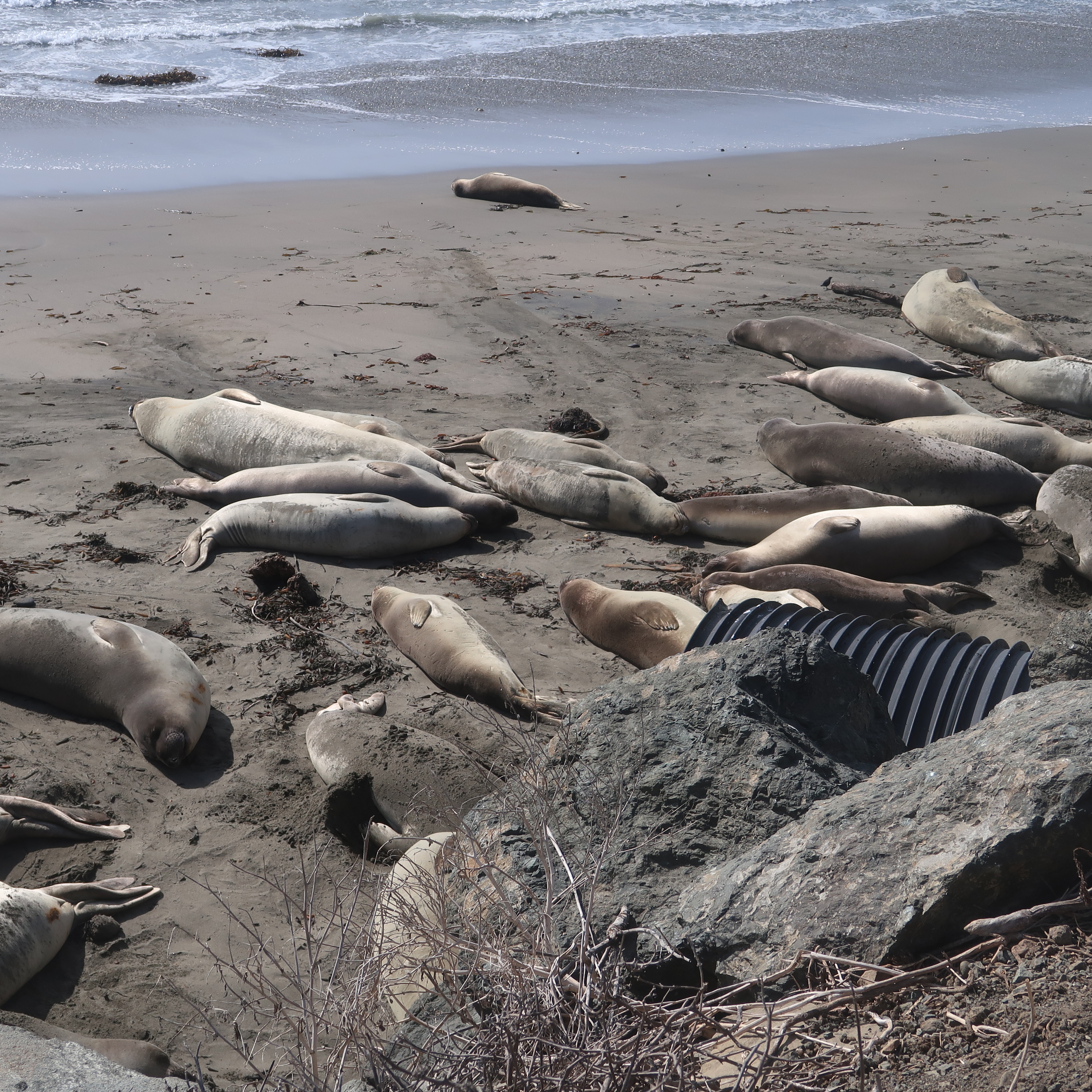
They are adjusting their migratory schedule. As they mature, they will return to the beach in December and January, for the breeding season. As juveniles, they avoid the hectic threats of that season by hauling out in the autumn months.
Local heroes
The Piedras Blancas site is featured in Smithsonian magazine.
This beach is an unusual success story at the intersection of humans and
wildlife. Typically, when wildlife crosses human paths, the wildlife loses out,
often catastrophically. In this case, the collaboration of state and local
agencies and passionate local residents made it work.
Instead of carnage, the site has become a tourist attraction
and an informal education center for ocean science. By training and managing volunteer
docents, Friends of the Elephant Seal plays a significant role in keeping seals
and visitors safe from each other.

At Piedras Blancas, that’s made simpler by the landscape of bluffs overlooking the beach. The boardwalks keep visitors safe while providing unlimited viewing.
During the breeding season, it’s more complicated. Subdominant
bulls, chased off the breeding beaches, come to San Simeon Cove to heal their
wounds. FES has a special program to help visitors there navigate around the
bulls.
It can be a delicate dance, but visitors come to the beach because they love the ocean. They are revived and renewed. With FES guides providing informal education about these amazing animals, both sides can safely coexist.

Speakers Bureau
Friends of the Elephant Seal offers presentations to local
organizations in SLO County. Trained speakers have given presentations to more
than 100 clubs and organizations, almost 3,000 persons in recent years, despite
the Covid hiatus.
Speakers are fully self-contained and travel with all the
audio and visual equipment needed to give their presentation to any age group
and size of audience.
The Speakers Bureau has slide and video presentations
introducing the Piedras Blancas rookery as well as each of the seasons in the
seals’ annual cycle. The Birthing and Breeding presentations are appropriate
now, since that season begins in December.
Speakers Bureau presentations are appropriate for civic
clubs, schools, libraries, associations, churches, charitable organizations and
other common interest groups. There is no charge to the group for this
educational service.
To arrange a speaker, call the FES office, (805) 924-1628 or
request a speaker through the website.
The Speaker’s Bureau Coordinator will respond and set up a date.
Thursday, September 28, 2023
Back for Haul-Out!
Young seals have the beach to themselves
Every day, more young seals arrive at Piedras Blancas
elephant seal beaches. They are here for the annual haul-out.
Hundreds of them sleep on the beach and spar with each
other, on the sand and in the water. You can tell a lot about them by observing
their size, nose development, scars, and identification tags and marks.

Seals or sardines? Young seals sleep peacefully on the sand. (Christine Heinrichs photo)
Which seal is which
Bigger seals are older seals, but the smallest may be
the Young of the Year, last year’s pups returning from their first migration.
Big welcome back for those that survived!
Most of the young seals are males. Although half of
pups born are male and half are female, females mature faster. Some are
pregnant by two years old, and nearly all by age four. They have already joined
the adult herd, so more males are among the juveniles on the beach now.
Males start growing that distinctive nose when they
are about five. It continues to grow throughout their lives. Compare nose size
among the young seals on the sand for relative age.
 |
| Two young seals show off their growing noses as they spar in the surf. (Chrisitne Heinrichs photo) |
Migratory seals
Most young seals don’t have many scars, but they may
have tags or dyed identification numbers. This is a Citizen Science
opportunity. Report any identifying marks to Friends of the Elephant Seal
docents, or go to the website to submit a report.
Reports of marked and tagged seals tells the
researchers who marked them where the seals are now. That research has revealed
how far the seals traveled, further than even the scientists imagined.
Compare the migration of juveniles and adult seals on
the maps at UC Santa Cruz’s Beltran Lab.
Seals differ in their migratory timing. Some juveniles
don’t return in the fall at all. Because they are always coming and going, every
day is different at the viewpoint. They aren’t like a flock of birds or a herd
of wildebeests. Each seal is gradually adjusting when to arrive and depart. As
they mature, they will coordinate their migrations with the rest of the adults,
and join the breeding herd in December.
San Simeon Cove Winter Guides
Friends of the Elephant Seal is recruiting volunteers for
special duty at San Simeon Cove, December through March. That’s elephant seal
breeding season. Although Piedras Blancas rookery is the main local breeding
area, subdominant bulls that are chased off those beaches often come to San
Simeon Cove to rest and recuperate from their battle wounds.
.JPG)
That can be a problem, when human visitors and their
dogs come to the beach. They don’t expect to share the beach with two-ton
seals. FES’s trained Winter Guides help keep everyone safe by advising visitors
how to navigate around the seals. It’s a teachable moment for the public to
learn about the wildlife who whom we share the world.
The bull seals aren’t aggressive toward beachgoers, but
they can be dangerous. Visitors need to keep their dogs from annoying the seals,
and stay well back. Seals may challenge each other, or decide to return to the
ocean without warning to visitors strolling down the beach.
FES trains volunteers to educate the public and help
everyone enjoy visiting the beach. Join them by applying online by October 16. Questions?
Call 805-924-1628. Must be 18 or older. Commit to two four-hour shifts a month,
December through March. Must be friendly, outgoing, able to stand for three to
four hours and walk on the beach in a variety of weather conditions – and love
the seals.
“This
is a great opportunity to learn more about elephant seal behavior in a unique
environment,” FES board president Kathy Curtis said in a press release.
“Seasonal residents, weekend travelers, couples, students and full-time
employees are encouraged to apply for this short-term volunteer experience.”
Subscribe to:
Posts (Atom)