John FitzRandolph reports on a young humpback whale in San Simeon Cove:
This story could develop into the North Coast’s marine
mammal mystery of the year, and it could prove to be among the most
treasured wildlife encounters witnessed here in many years.
For 24
consecutive days (as of Tuesday, Aug. 4), a juvenile humpback whale has
been dining on anchovies, sardines and other small bait fish in the San
Simeon Cove.
Why has this whale lingered for so many days in the
Cove? If there are ample schools of bait fish in the Cove, why aren’t
there other whales feeding there as well — as there have been in recent
weeks?
Read the rest of his story here.
So this story about humpback whale songs caught my attention: NPR reports:
Humpback whales don't just sing songs — they compose
with the whales around them, singing a song that evolves over time.
Scientists didn't know that until they started recording whale sounds in
the 1960s and spent years listening. The evolution of this "culture of
listening" among researchers is the focus of Morning Edition's weekly summer series, Close Listening: Decoding Nature Through Sound.
Katy
Payne, a researcher in acoustic biology at the Cornell Lab of
Ornithology, and her husband, Roger, were the first scientists to
realize that the intricate and eerie calls of some humpback whales are
actually songs. At a recent visit with Katy in a Cornell sound studio,
we played this archived recording of the first whale they ever heard,
and she recognized it right away:
"It's the voice of a male humpback whale off shore of Bermuda, in 1964," Katy explained. "It was recorded by a Navy engineer."
Read or listen to the rest of the story here.
Tuesday, August 18, 2015
Wednesday, August 12, 2015
Hawaiian Monk Seals
We don't see these rare and endangered seals in California, but their plight concerns us all. John Platt writes about them on Motherboard:
Fans of “The Walking Dead” know it doesn’t take much to start a species-ending apocalypse.
A bite. A scratch. A sneeze. One opportunity to pass a pathogen to someone else and the race toward extinction begins.
That fictional scenario is scary enough, but for some species the reality is even more terrifying—and more likely to happen sometime in the not-so-distant future.
Take the Hawaiian monk seal. Once hunted into near-extinction for their meat and fur in the 19th century, only a few hundred monk seals remained when they were finally protected under the Endangered Species Act in 1976. Intense conservation efforts increased that population to about 1,500 in the 1980s, but the seals still face a precarious recovery. The animals frequently die from entanglement with fishing gear and their population has shrunk to about 1,100 today.
The seals still carry scars from that close call
with extinction. The species has the lowest genetic diversity of any of
the world’s seal species, which means they have a similarly low
resistance to disease. The introduction of a virus to the ecosystem
could easily wipe out the species, said Charles Littnan, lead scientist
for the National Oceanic and Atmospheric Administration’s Hawaiian Monk Seal Research Program.
Around the world, seals and other marine species have experienced several mass die-offs after exposure to morbilliviruses, a group of diseases that include canine distemper and the measles.
“The destructive force of a disease is comparable to nothing,” Littnan said. “There is no reason to believe that if morbillivirus comes and gets into monk seals, and this program isn’t in place, that it will be anything less than catastrophic.”
Read the rest of the story here.
Fans of “The Walking Dead” know it doesn’t take much to start a species-ending apocalypse.
A bite. A scratch. A sneeze. One opportunity to pass a pathogen to someone else and the race toward extinction begins.
That fictional scenario is scary enough, but for some species the reality is even more terrifying—and more likely to happen sometime in the not-so-distant future.
Take the Hawaiian monk seal. Once hunted into near-extinction for their meat and fur in the 19th century, only a few hundred monk seals remained when they were finally protected under the Endangered Species Act in 1976. Intense conservation efforts increased that population to about 1,500 in the 1980s, but the seals still face a precarious recovery. The animals frequently die from entanglement with fishing gear and their population has shrunk to about 1,100 today.
 |
| Hawaiian Monk seal mother and pup. NOAA photo |
This is not a theoretical danger.
Around the world, seals and other marine species have experienced several mass die-offs after exposure to morbilliviruses, a group of diseases that include canine distemper and the measles.
“The destructive force of a disease is comparable to nothing,” Littnan said. “There is no reason to believe that if morbillivirus comes and gets into monk seals, and this program isn’t in place, that it will be anything less than catastrophic.”
Read the rest of the story here.
Thursday, July 9, 2015
Green Tie
This could be Green Tie, a seal who was entangled in green plastic packing strip back in 2011. He was energetically tussling with other seals in the surf. The scar looks deep, so he is probably not entangled any more.


 Welcome back, Green Tie!


Saturday, June 27, 2015
Good-bye Girls
From my column in The Cambrian:
The crowds thin out in June. Not the people, the seals. The beach that was covered with seals now shows plenty of sand between them. Fewer but larger, the subadult males are on the beach to molt their skin in June and July. The biggest adult males will return in July and August.
Subadult means that they are growing that distinctive elephant seal nose (technically it’s a
proboscis, a long nose), but aren’t fully mature. Their skin peels off once a year, and they spend four to six weeks on the beach looking terrible.
Tap
a Friends of the Elephant Seal docent — a guide in a blue jacket — and
ask to touch some of the shed skin. They carry samples to share with the
public.
The beach is less crowded than the crush of May, when the adult females and the juvenile seals of both sexes rested on the beach for their molt.
They have now left the beach, swimming off in
their new skin. The juveniles will return in September for their fall
rest, but the females won’t come back until January, when they return to
have pups. They have set off for an 8-month migration, to eat and grow
pups.
They’ll be finding fish and squid to eat in deep waters. Wildlife habitat on land is easy to understand. It’s the woods, the plains, the fields. In the ocean, it’s not so obvious. It’s complex and three-dimensional, with zones of different temperature, density and salinity.
Tracking a seal at sea
Elephant seals’ main foraging habitat is at 1,000 feet and deeper, dark and cold. In this record of 17 hours in one day of a female elephant seal’s life, she spent most of her time around 2,000 feet. She came to the surface only briefly, for two or three minutes, to breathe, get all the oxygen she needed, and dived down again. Dives deeper than a mile have been recorded.
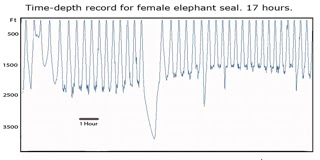
Most of her dives were 20 to 30 minutes. She coasted most of the way, then the jagged line indicated that she was chasing and catching prey. She came back to the surface and breathed rapidly. Her heartbeat was about 100 beats a minute at the surface, as her body flushed spent carbon dioxide and replaced it with oxygen, in her blood and muscles. Because she needs oxygen to sustain her during those long dives, her muscles have oxygen-carrying myoglobin to keep her supplied.
That accomplished, she dived back down, her heart rate slowing to about 25 beats a minute. Her blood circulation became reduced, giving priority to the brain and heart, but letting the muscles and organs rely on myoglobin.
Then there’s that one long dive, over an hour past 4,000 feet. She could have been escaping from a predator, or she could have been sleeping on the way down.
Filling in the blanks
She doesn’t need to propel herself actively downward. Seals can just coast down through the water, like a falling leaf. Seals have to sleep some time. Since they are continually diving and returning to the surface, perhaps they nap on the way down on some dives.
Exactly how she hunts isn’t yet known. Those big eyes indicate that she’s hunting by sight to some extent. When I first learned about elephant seals, that seemed odd. It’s far too dark to see anything at those depths. Light from the surface penetrates only about 650 feet. But some of her prey is bioluminescent. Those squid flash light. Her sensitive whiskers can detect slight movements and help her find prey, too.
While they are migrating, elephant seals are seldom seen by humans. They’re under water, far from human observation. Digital technology allows us to gather data and use it as a route to understanding these complicated animals, which we observe only when they are on the beach, not in the deep-water habitat where they spend most of their lives.
The crowds thin out in June. Not the people, the seals. The beach that was covered with seals now shows plenty of sand between them. Fewer but larger, the subadult males are on the beach to molt their skin in June and July. The biggest adult males will return in July and August.
Subadult means that they are growing that distinctive elephant seal nose (technically it’s a
proboscis, a long nose), but aren’t fully mature. Their skin peels off once a year, and they spend four to six weeks on the beach looking terrible.
 |
| A six-year-old faces off with a seven-year-old |
The beach is less crowded than the crush of May, when the adult females and the juvenile seals of both sexes rested on the beach for their molt.
 | |
| There's space between seals in June |
They’ll be finding fish and squid to eat in deep waters. Wildlife habitat on land is easy to understand. It’s the woods, the plains, the fields. In the ocean, it’s not so obvious. It’s complex and three-dimensional, with zones of different temperature, density and salinity.
Tracking a seal at sea
Elephant seals’ main foraging habitat is at 1,000 feet and deeper, dark and cold. In this record of 17 hours in one day of a female elephant seal’s life, she spent most of her time around 2,000 feet. She came to the surface only briefly, for two or three minutes, to breathe, get all the oxygen she needed, and dived down again. Dives deeper than a mile have been recorded.
Most of her dives were 20 to 30 minutes. She coasted most of the way, then the jagged line indicated that she was chasing and catching prey. She came back to the surface and breathed rapidly. Her heartbeat was about 100 beats a minute at the surface, as her body flushed spent carbon dioxide and replaced it with oxygen, in her blood and muscles. Because she needs oxygen to sustain her during those long dives, her muscles have oxygen-carrying myoglobin to keep her supplied.
That accomplished, she dived back down, her heart rate slowing to about 25 beats a minute. Her blood circulation became reduced, giving priority to the brain and heart, but letting the muscles and organs rely on myoglobin.
Then there’s that one long dive, over an hour past 4,000 feet. She could have been escaping from a predator, or she could have been sleeping on the way down.
Filling in the blanks
She doesn’t need to propel herself actively downward. Seals can just coast down through the water, like a falling leaf. Seals have to sleep some time. Since they are continually diving and returning to the surface, perhaps they nap on the way down on some dives.
Exactly how she hunts isn’t yet known. Those big eyes indicate that she’s hunting by sight to some extent. When I first learned about elephant seals, that seemed odd. It’s far too dark to see anything at those depths. Light from the surface penetrates only about 650 feet. But some of her prey is bioluminescent. Those squid flash light. Her sensitive whiskers can detect slight movements and help her find prey, too.
While they are migrating, elephant seals are seldom seen by humans. They’re under water, far from human observation. Digital technology allows us to gather data and use it as a route to understanding these complicated animals, which we observe only when they are on the beach, not in the deep-water habitat where they spend most of their lives.
Monday, June 15, 2015
June Gloom
That's what we call the fog that is typical for the Central Coast in June. Fuine my me. I'm no more a fan of the hot sun than the seals are.
They rest peacefully on the beach at this time of year.
 The females are leaving, so fewer are on the beach, but subadult males are arriving. They will molt for the next month or so, then the adult males will arrive.
Fewer at the top!

His nose is starting to grow, but he is not fully matire. Still, he's a good sized seal!

They rest peacefully on the beach at this time of year.

Fewer at the top!

 | |||
| The nose on this seal indicates that he is about five years old. |

Tuesday, May 19, 2015
New fence


Tuesday, May 12, 2015
Drone photographs migrating whales
Kathe Tanner writes about the new technology being used to monitor Californa Gray Whales as they migrate along our coast:
As fisheries biologists tally their 22nd springtime count of northbound mother and baby gray whale pairs migrating past Point Piedras Blancas on their way to Alaska, scientists are getting a better look than ever at the cetaceans, thanks to eyes in the sky — in the belly of a $25,000 hexacopter, a kind of drone.
Read the rest at http://www.sanluisobispo.com/2015/05/07/3623531/whales-enter-the-drone-zone-at.html.
As fisheries biologists tally their 22nd springtime count of northbound mother and baby gray whale pairs migrating past Point Piedras Blancas on their way to Alaska, scientists are getting a better look than ever at the cetaceans, thanks to eyes in the sky — in the belly of a $25,000 hexacopter, a kind of drone.
Read the rest at http://www.sanluisobispo.com/2015/05/07/3623531/whales-enter-the-drone-zone-at.html.
Subscribe to:
Posts (Atom)